
E-Verify Login: How Employers Sign In Through Login.gov
Read the article

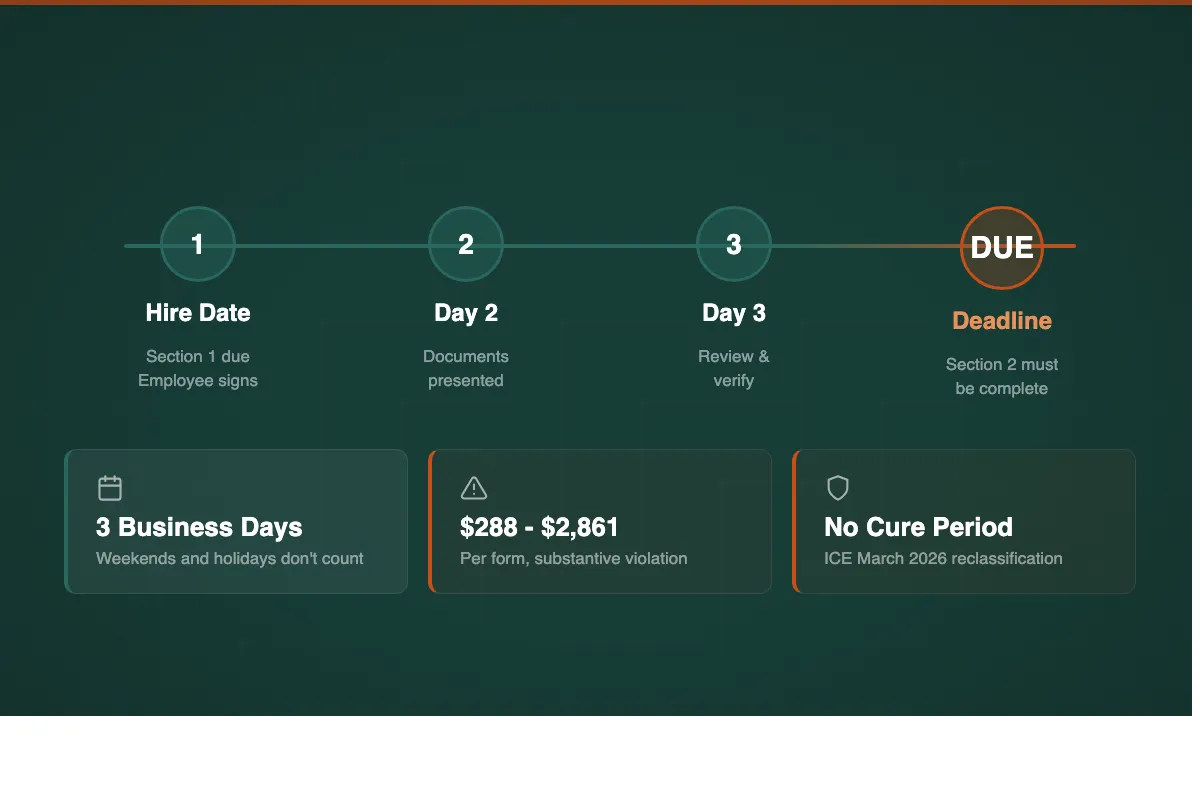
The I-9 3 day rule requires employers to complete Section 2 of Form I-9 within three business days of an employee's first day of work for pay. Miss this deadline and your company faces fines of $288 to $2,861 per form — and under ICE's March 2026 enforcement update, late completion is now classified as a substantive violation with no correction window.
This guide breaks down exactly how the 3 day rule works, what counts as "day one," the exceptions that trip up employers, and how to build a system that never misses a deadline.
The rule has two parts with two different deadlines:
The hire date — what U.S. Citizenship and Immigration Services (USCIS) calls the "first day of employment" — means the actual commencement of employment for wages or other remuneration. Not the date the offer letter was signed. Not the orientation date if orientation is unpaid. The first day the employee works for pay.
USCIS provides this example: If your employee begins work for pay on Monday, you must complete Section 2 by Thursday of that week.
A business day is a day your business is actually open and operating. For most office-based employers, that's Monday through Friday, excluding federal holidays. For employers that operate seven days a week — restaurants, hotels, hospitals, retail, transportation, manufacturing, agriculture — Saturdays and Sundays count as business days.
This is one of the most misunderstood parts of the three-day rule. The "business day" clock follows your business schedule, not the standard Monday-to-Friday workweek. If your operation runs Saturdays and Sundays, those days count toward the Section 2 deadline. If a federal holiday falls on a day your business is open and people are working, it counts. If you're closed Mondays, Mondays don't count.
The practical test: if your business is open and your HR or onboarding staff could complete Section 2 on a given day, that day counts as a business day for the purpose of the three-day rule.
| Start Date (Day 1) | Operation Type | Section 2 Deadline |
|---|---|---|
| Monday | Standard Mon–Fri office | Thursday (same week) |
| Wednesday | Standard Mon–Fri office | Monday (following week — weekend doesn't count) |
| Thursday | Standard Mon–Fri office | Tuesday (following week — weekend doesn't count) |
| Friday before a holiday Monday | Standard Mon–Fri office | Thursday (following week — holiday doesn't count) |
| Friday | 7-day operation (restaurant, hotel, hospital, retail) | Monday (Sat + Sun count as business days) |
| Saturday | 7-day operation | Tuesday |
The start date itself counts as day one. If an employee starts on Monday at a Mon–Fri office, that's day one. Tuesday is day two. Wednesday is day three. Thursday is the deadline. If an employee starts on Friday at a 24/7 hospital, Friday is day one, Saturday is day two, Sunday is day three, and Monday is the deadline.
A note for restaurants, hospitality, retail, and 24/7 operations: This is the part of the three-day rule that trips up the most employers we work with. If you operate seven days a week, you cannot rely on the "weekends don't count" rule that office employers use. We recommend building your onboarding workflow around the assumption that the I-9 clock runs every day your business is open — because for ICE auditors, that's exactly how it gets evaluated.
If you hire someone for a job that will last fewer than three business days, the standard three-day window does not apply. You must complete Section 2 no later than the first day of work for pay.
This matters most for:
Staffing agencies have an additional consideration: USCIS allows them to use either the date an employee is assigned to their first job or the date the new employee is entered into the assignment pool as the first day of employment.
Yes. USCIS allows employers to review documents and fully complete Section 2 any time between the date the employee accepts the job offer and three business days after the hire date. Many employers use this window to complete the entire Form I-9 during the gap between offer acceptance and start date.
If you complete Section 2 before the employee's actual start date, enter the date the employee is expected to begin work in the "first day of employment" field. If the actual start date changes, cross out the expected date, write in the correct date, and initial the correction.
For a full breakdown of pre-start-date completion, see our guide: Can I-9 Be Completed Prior to Start Date?
Missing the three-day window puts your company at immediate risk. Here's what's at stake:
Fines. Paperwork violations carry penalties of $288 to $2,861 per Form I-9 under the January 2025 inflation adjustment (8 CFR § 274a.10). A company that onboards 50 employees per year with a 10% late-completion rate faces $1,440 to $14,305 in potential fines.
No correction window. As of March 16, 2026, ICE's updated I-9 Inspection Fact Sheet reclassifies the failure to ensure timely preparation of Section 1 and timely completion of Section 2 as a substantive violation. Previously, some timing errors were treated as technical violations with a 10-day correction period. That window is gone.
Audit exposure. Late I-9 completions are one of the first things U.S. Immigration and Customs Enforcement (ICE) looks for during an audit. The date the employee began employment in Section 2 is compared to the date the employer signed the certification. If the gap exceeds three business days, it's flagged automatically.
For current fine amounts across all violation types, see our complete guide: I-9 Penalties in 2026
i9 Intelligence automates I-9 completion tracking so your team never misses the three-day window. Our platform sends deadline reminders, flags incomplete forms in real-time, and provides a complete audit trail showing exactly when each section was completed. Schedule a free compliance call to see how it works, or calculate your company's current risk exposure.
If your employee fails to present acceptable documentation — or an acceptable receipt for a document — within three business days of their start date, you may terminate their employment. USCIS is clear on this point.
However, you must give the employee the full three business days. You cannot require documents on day one (unless the job lasts fewer than three days). And you cannot specify which documents the employee must present — they choose from the Lists of Acceptable Documents.
If an employee presents a receipt instead of the actual document, they have 90 days from the date of hire to present the actual document the receipt was issued for.
If you rehire a former employee within three years of the original Form I-9 date, you may use Supplement B (formerly Section 3) to reverify instead of completing a new Form I-9. The three-day deadline still applies — you must complete Supplement B within three business days of the rehire date. Many employers choose to complete a new Form I-9 for rehires to avoid complications.
It depends on whether your business is open on weekends. For standard Monday-to-Friday office employers, weekends do not count. If an employee starts work on Thursday, the deadline to complete Section 2 is the following Tuesday. For seven-day operations — restaurants, hotels, hospitals, retail, manufacturing, transportation — Saturdays and Sundays DO count as business days because the business is open and operating. A hospital employee who starts on Friday has a Section 2 deadline of Monday, not Wednesday.
Yes. Electronic I-9 completion is legal under 8 CFR 274a.2 as long as your system meets the regulatory requirements for electronic signatures, storage, and retrieval. Electronic systems can also automate deadline tracking so you never miss the three-day window.
For a standard Monday-to-Friday office: count business days only. Friday is day one. If Monday is a federal holiday, then Tuesday is day two, Wednesday is day three, and Thursday is the deadline. The holiday and weekend days don't count. For a seven-day operation where your business is open Saturday, Sunday, and the federal holiday, all of those days count toward the deadline — a Friday start at a 24/7 hospital means a Sunday deadline.
As of March 2026, ICE classifies the failure to ensure timely completion of Section 1 and Section 2 as a substantive violation. This means there is no 10-day correction window. Late completions carry immediate fine exposure of $288 to $2,861 per Form I-9.
Patricia Duarte, I-9 Compliance Director at i9 Intelligence with 14 years of I-9 and E-Verify experience, notes: "The three-day window sounds generous until you're onboarding fifteen people on Monday and three of them are remote. That's where employers get in trouble — not because they don't know the rule, but because they don't have a system to track it across every hire."
Our compliance team is available Monday through Friday, 8 AM to 5 PM CT.