Requirements
What every employer must do

Every employee hired in the U.S. since 1986 requires a completed Form I-9. This guide covers requirements, deadlines, penalties, and how to stay compliant at every stage.
Form I-9, Employment Eligibility Verification, is a federal form that every U.S. employer must complete for each employee hired after November 6, 1986. The requirement comes from the Immigration Reform and Control Act of 1986 (IRCA) and is enforced by U.S. Immigration and Customs Enforcement (ICE).
The form verifies two things: the employee's identity and their authorization to work in the United States. I-9 compliance means completing the form correctly, on time, for every employee — and maintaining those records for as long as the law requires.
Employee completes by their first day of work for pay
Employer examines documents within 3 business days of hire
Preparer or translator helps the employee complete Section 1
Reverification (when work authorization expires) or rehires
E-Verify is a separate but related system. It compares I-9 data against federal databases to confirm work authorization. E-Verify is voluntary in most states but mandatory in others and for most federal contractors.
Every employer must follow these steps for each new hire. Missing any one of them is a potential violation.
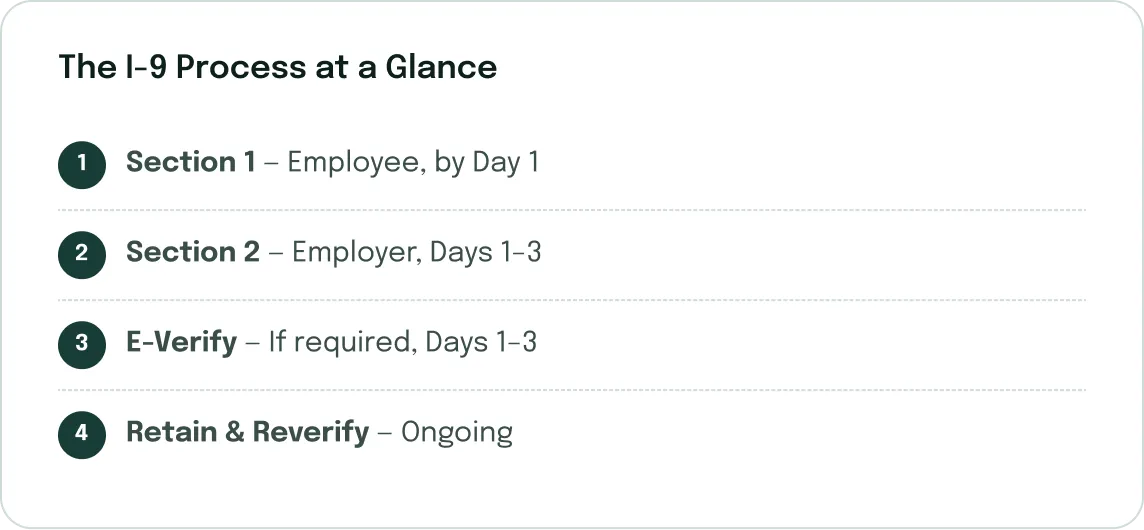
The employee may complete Section 1 any time after accepting the job offer, but no later than their first day of work for pay. They attest to their citizenship or immigration status and provide their name, address, date of birth, and Social Security number (SSN is optional unless the employer uses E-Verify).
The employer or an authorized representative physically examines the employee's original identity and employment authorization documents. The employee chooses which documents to present from the Lists of Acceptable Documents — List A (identity + work authorization) or List B + List C (identity + work authorization separately). Section 2 must be completed within 3 business days of the hire date.
If the employer participates in E-Verify — voluntarily or by mandate — they must submit a case within 3 business days of hire. The employee's SSN is required for E-Verify. Do you need to use E-Verify?
For employees with temporary work authorization (H-1B, OPT, TPS, EAD holders), the employer must track when authorization expires and reverify on Supplement B before the expiration date. USCIS recommends sending reminders 90 days in advance.
Form I-9 must be retained for 3 years after the date of hire or 1 year after the date of termination — whichever is later. Records must be producible within 3 business days if ICE issues a Notice of Inspection. Calculate your retention dates →
If you discover errors on a completed I-9, correct them using the proper procedure — single-line strikethrough, initial, and date. Do not backdate, white out, or create a new form to replace a corrected one. Learn how to self-audit your I-9s.
These are the most common errors ICE finds during I-9 audits. Each one can result in fines of $288 to $2,861 per form — or worse if the mistake looks intentional.
Section 2 must be completed within 3 business days of the employee's first day of work for pay. A form completed on day 4 is a violation — even if the employee is authorized to work. "Business days" means days the employer's business is open, which may include weekends for 7-day operations.
Employers cannot ask an employee to present a specific document. The employee chooses from the Lists of Acceptable Documents. Saying "bring your passport" or "we need a driver's license" is document abuse under the Immigration and Nationality Act (8 U.S.C. 1324b). Common document questions
When a foreign worker's authorization expires, the employer must reverify on Supplement B before the expiration date. Missing this deadline is one of the most common violations for employers with H-1B, OPT, or TPS workers. Reverification guide
Documents presented for Section 2 must be unexpired (with certain exceptions for auto-extended EADs and receipts). Accepting clearly expired documents is a Section 2 violation.
Every I-9 must be retained for the legally required period. Premature destruction or inability to produce records during an audit triggers penalties of $288 to $2,861 per missing form.
Employees hired before November 7, 1986 are grandfathered in — no I-9 is required. Creating retroactive I-9s for these employees generates audit risk where none existed.
E-Verify can only be used for initial hires. Running a new E-Verify case when reverifying an existing employee violates program rules. Reverification happens on Supplement B only.
Completing I-9s one way at headquarters and a different way at branch offices invites discrimination claims and audit findings. Procedures must be consistent — especially for remote employees
Penalties are adjusted annually for inflation. These are the current amounts effective January 2, 2025.
Full breakdown of current penalty amounts, how they're calculated, and what triggers an audit.
State mandates, federal contractor requirements, and how to know if E-Verify applies to you.
Step-by-step process for finding and fixing errors before ICE does.
Who can complete Section 2 on the employer's behalf and what that means legally.
When and how to reverify employees on Supplement B without creating compliance risk.
How to complete I-9 Section 2 remotely for distributed teams with authorized representatives.
I-9 compliance means correctly completing, storing, and maintaining Form I-9, Employment Eligibility Verification, for every employee hired after November 6, 1986. It includes completing Section 1 (employee) and Section 2 (employer) on time, examining acceptable documents, tracking reverification dates, and retaining records for the legally required period.
Every employer in the United States must complete Form I-9 for each person they hire for employment. This applies to all employees regardless of citizenship status — U.S. citizens, permanent residents, and authorized foreign workers all require a completed I-9.
The employee must complete Section 1 by their first day of work for pay. The employer must complete Section 2 within 3 business days of the hire date. For employees hired for less than 3 business days, Section 2 must be completed on the first day of work.
Penalties range from $288 to $2,861 per form for paperwork violations to $716–$28,619 per worker for knowingly hiring unauthorized workers. Repeat offenders face escalating fines and potential criminal prosecution. Penalties are adjusted annually for inflation.
Form I-9 is a mandatory paper or electronic form that every employer must complete. E-Verify is a separate, web-based system that compares I-9 data against government databases. E-Verify is voluntary for most employers but mandatory in some states and for federal contractors. Employers who use E-Verify must still complete Form I-9.
Employers must retain Form I-9 for 3 years after the date of hire or 1 year after the date of termination — whichever is later. Records must be producible within 3 business days if ICE issues a Notice of Inspection.
Employers enrolled in E-Verify can use the DHS-authorized alternative procedure to examine documents remotely via live video call. Employers not enrolled in E-Verify must arrange for an authorized representative to examine documents in person at the employee's location.