
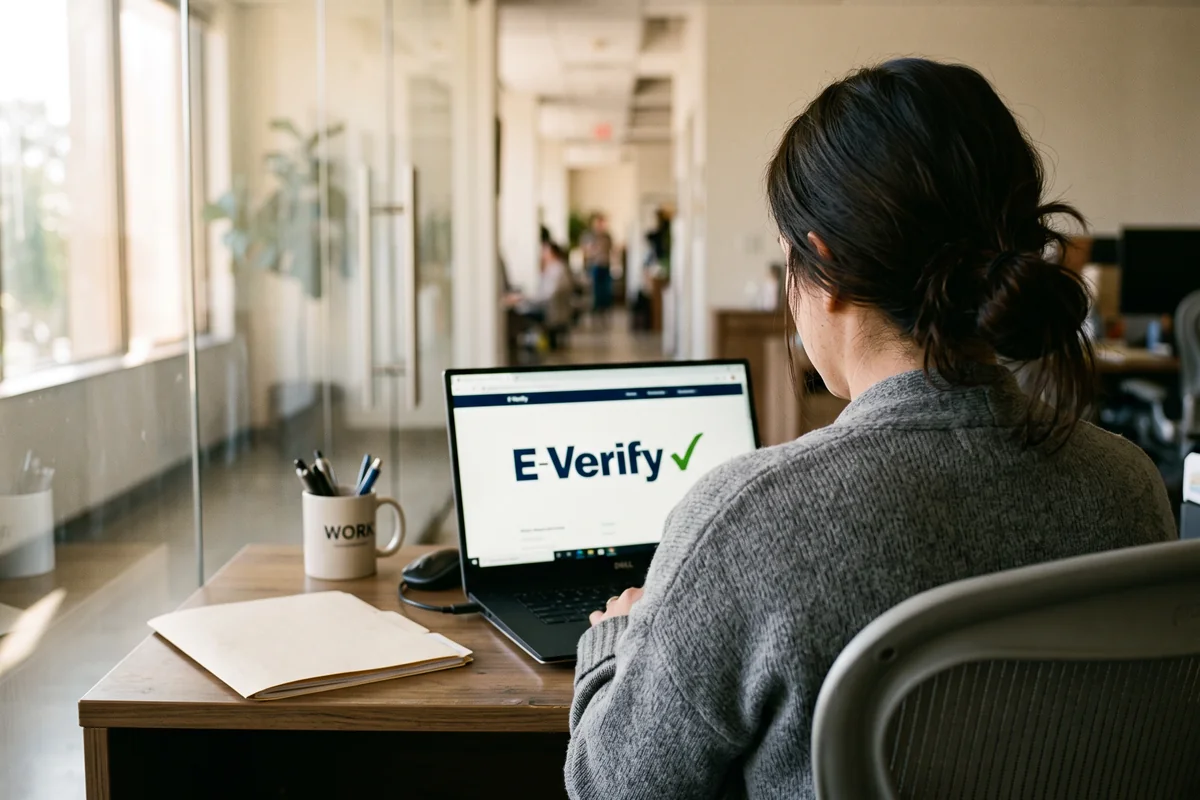
Green Cards, Driver's Licenses, and I-9 Reverification: What the Whirlpool Settlement Shows
Read the article

On September 22, 2026, U.S. Citizenship and Immigration Services (USCIS) released version 32 of the E-Verify Interface Control Agreement (ICA), the technical rulebook for every software vendor and E-Verify employer agent that submits cases to E-Verify on an employer's behalf. It is not a regulation, and Form I-9 itself does not change. Vendors have until March 31, 2027 to pass E-Verify's new acceptance testing and move to v32; after that date, the v31 connection is deprecated.
For employers, two things change: getting enrolled in E-Verify through a vendor gets much faster, and every case your vendor submits will tell E-Verify more than it does today. That includes the hiring site where the employee works, whether Section 2 documents were reviewed remotely, how an expired-looking Employment Authorization Document (EAD) or green card is extended, and the name of the software that sent the case.
This is the biggest practical change in v32. Until now, an E-Verify employer agent enrolled each client by working through the E-Verify web application screen by screen: employer category, company information, NAICS code, hiring sites, then the Memorandum of Understanding (MOU) signatory. The employer agent guide still describes that process.
Version 32 adds an Enrollment API. Your vendor can build the whole enrollment inside its own software and send it to E-Verify in one request: company details, hiring sites, and contacts, with the category and industry codes pulled from E-Verify's own reference lists so the entries validate the first time. E-Verify creates the account in pending status and emails the MOU link to your signatory.
| Enrollment step | Before v32 | With v32 |
|---|---|---|
| Company information | Agent keys it into E-Verify's web screens | Vendor submits it from its own platform in one enrollment request |
| Hiring sites | Added in the web app, one at a time or by bulk upload | Created, edited, and deleted by API; up to 5,000 sites per batch |
| MOU signature | Emailed link, 24 hours to sign; agent resends from the web app | Emailed link, 24 hours to sign; vendor resends from its own platform |
| Account status | Checked in the web app | Vendor checks it automatically; the account turns active once the MOU is signed |
For a single-location employer, this saves an afternoon. For a restaurant group, a staffing firm, or a retailer with hundreds of stores, the hiring-site list was always the slow part, and it is exactly the part v32 automates. The person named as your MOU signatory still signs personally, and the 24-hour window still applies, so tell that person the email is coming.
Faster enrollment also matters for remote hiring. DHS only allows the optional alternative procedure (remote document review by live video) at hiring sites enrolled in E-Verify and in good standing. An employer that needs remote Section 2 next week needs E-Verify running at the right sites first.
The Enrollment API is optional. A vendor gets access only after passing two separate E-Verify acceptance tests, one for cases and one for enrollment, so ask whether yours plans to offer it.
"Enrollment is the part of E-Verify nobody budgets time for," says Jed Butler, CEO of i9 Intelligence. "The case work is fast. What slows a multi-location employer down is getting every site entered correctly and catching the signatory before the MOU link expires. Moving that into the vendor's system means a new client can be running cases sooner, and for remote hires that means getting to remote Section 2 sooner too."
Under v32, a hiring site is a required field on every new E-Verify case. The vendor pulls the list of valid sites for your account and attaches one to each case, so E-Verify will know which location every new hire belongs to.
Remote hires need a decision. The ICA says a remote employee should be associated with the hiring site responsible for completing that employee's Form I-9. E-Verify's employer agent guidance goes further: when a third-party employer agent completes Form I-9 for a remote hire, the hiring site is the agent's location, not the employee's home. If an employee is attached to a site that does not participate in E-Verify, they cannot be verified at all.
The practical work here is housekeeping. Stores open and close, and warehouses get consolidated. If the site list in E-Verify drifts from the list in your HR system, cases will start landing on the wrong location, or failing, once your vendor moves to v32.
The hiring-site list is where multi-location rollouts stall. i9 Intelligence is building v32 support now, including the new enrollment tools, and already enrolls clients and runs E-Verify as their E-Verify employer agent at no extra cost, with remote Section 2 for new hires anywhere in the U.S. Schedule a free compliance call to map your sites before the v32 cutover.
Two new required answers now travel with every case your vendor creates:
Form I-9 has carried an alternative-procedure checkbox in Section 2 since the 08/01/2023 edition. What v32 adds is that E-Verify receives the answer for every case submitted through software, next to the hiring site. DHS will have a case-level record of which employers, and which sites, use remote review.
That makes the existing rules easier to check. If you offer remote review at a site, you must offer it consistently to all employees at that site, or limit it to remote hires only without a discriminatory purpose. You must also keep clear copies, front and back, of every document examined remotely. An audit that compares your remote-review answers in E-Verify against the copies in your I-9 files will find the gaps quickly. Our guide to remote I-9 verification covers the full procedure.
When an employee presents a document that looks expired but is still valid through an extension, v32 asks the vendor to record exactly how it is extended.
| Document presented | What the case now records |
|---|---|
| Expired EAD (Form I-766) with an extension | The extension method: a Form I-797 or I-797C notice (with its document number), a Temporary Protected Status (TPS) Federal Register notice, or a Deferred Enforced Departure (DED) Federal Register notice. For TPS or DED, the specific country. |
| Expired Permanent Resident Card (Form I-551) with a receipt notice | The Form I-797 or I-797C document number and the form type the receipt notice relates to. |
E-Verify now publishes its own reference lists of TPS-designated and DED-covered countries, each tied to the current Federal Register notice. The vendor has to pick from those lists, so the person completing Section 2 needs to know which extension the employee is actually relying on. "The card is expired but they said it's fine" will not fit in the form.
There is a second effect. When a TPS designation ends, E-Verify will already hold a structured record of which cases relied on that country's automatic extension. Keep your reverification dates tied to the same notice. Our TPS employer guide and EAD guide cover how those extensions work on Form I-9.
Every case created under v32 carries a required field with the official name of the software provider that generated it. The ICA says this lets E-Verify "track and audit the source of case submissions for operational and support purposes."
In practice, that gives E-Verify a way to look at case quality by vendor, such as late submissions and duplicate cases. The choice of I-9 and E-Verify software has always shaped the quality of an employer's records. Now the agency can see it directly.
| Change | What it means |
|---|---|
| Email and phone moved to the Confirm Case Details step | The case must say whether the employee entered an email and phone number in Section 1, and include them if so. It should match what is on Form I-9. |
| No closing a case at Confirm Case Details | E-Verify now returns an error if a case is closed at that step. |
| Duplicate-case rules tightened | When a duplicate reason is needed, it is required, and "Other" requires an explanation. |
| Late-case reason reworded | "Audit Revealed that New Hire Was Not Run" now reads "An audit revealed that a case was not created for a new hire." |
| Case updates filtered by client | Employer agents can pull case updates for one client company at a time. |
Most employers will never see the ICA. They will feel it when their vendor cuts over, or does not. If your E-Verify cases go out through an HCM such as Workday, ADP, or UKG, find out who actually submits them: the HCM or a partner behind it. That is the company that has to pass v32 testing. (We covered why that distinction matters in our HRIS integration gap article.)
No. The form, the Lists of Acceptable Documents, and the three-business-day deadline for Section 2 are the same. Version 32 changes what software vendors send to E-Verify when they create a case.
The ICA governs the web services connection that vendors and employer agents use. Employers who enter cases directly on the E-Verify website are not moving to a new API, though keeping your hiring-site list accurate is good practice either way.
E-Verify says the v31 APIs will be deprecated after that date. A vendor still on v31 would need to finish v32 testing before it could keep submitting cases, so ask for a cutover date in writing now rather than in March.
Phone: (713) 668-6200 (Mon–Fri, 8 AM – 5 PM CT)
Email: support@i-9intelligence.com
Submit a ticket: i-9intelligence.com/submit-a-ticket