
.webp)
How Much Does Remote I-9 Verification Cost? 2026 Prices Compared
Read the article

An EAD is an Employment Authorization Document (Form I-766), the photo card U.S. Citizenship and Immigration Services (USCIS) issues to noncitizens who are allowed to work in the United States for a set period. It lets the holder work until the "Card Expires" date printed on the front, and on Form I-9 it covers Section 2 by itself, with no second document needed.
People also call it a work permit or an EAD card. It has nothing to do with the Library of Congress "Encoded Archival Description," which shares the initials and sometimes gets blended into search answers. In immigration and HR, EAD means the USCIS card. This guide covers what the card is, how it compares to a green card, how EAD renewal works now that automatic extensions have mostly ended, and how employers record it on Form I-9.
The current card carries the holder's photo on the front and back, plus their name, USCIS number, date of birth, category code, and the card's expiration date. USCIS started issuing this design on January 30, 2023, and older designs stay valid until the date on the card (M-274, Section 13.1).
USCIS issues EADs under 8 CFR 274a.12 to people who can work here but aren't U.S. citizens or permanent residents. Common holders include:
Green card holders show Form I-551 instead, and U.S. citizens never need an EAD.
The category code sits under "Category" on the front of the card. C08 means a pending asylum case, C09 a pending green card application, and A05 an asylee. USCIS uses that code to decide which extension rules apply to a card, so read it off the plastic instead of going by what the employee says about their case.
Both cards come from USCIS, both are List A documents, and both have an expiration date on the front, but the two dates mean very different things to an employer. A green card's date only tells the holder when to replace the card, so employers don't reverify it (M-274, Section 8.1). An EAD's date is the deadline for reverification.
| EAD (Form I-766) | Green card (Form I-551) | |
|---|---|---|
| What it proves | Permission to work for a set period | Lawful permanent resident status |
| Renewed on | Form I-765 | Form I-90 |
| Form I-9 List A | Yes, document #4 | Yes, document #2 |
| Section 1 box | Box 4, authorized to work | Box 3, lawful permanent resident |
| Reverify when the card expires? | Yes | No |
"An EAD is List A, but it has an expiration date on the front," says Patricia Duarte, Director of Compliance at i9 Intelligence. "That date is a reverification trigger, not a suggestion. A green card in the same wallet does not get reverified. An EAD always does."
"Work permit" is the everyday name for the same EAD card. H-1B workers usually don't carry one at all, since their permission to work comes with H-1B status and they typically show a foreign passport with Form I-94. The full picture is in what is work authorization, and green card numbers are covered in green card number for I-9.
EAD renewal is filed on Form I-765, Application for Employment Authorization, the same form used for the first card. USCIS generally recommends filing a renewal up to 180 days before the current EAD expires (90 FR 48799; uscis.gov/i-765). Employees should file as early as USCIS allows, because the old safety net is mostly gone.
Most renewals filed on or after October 30, 2025 get no automatic extension. A DHS interim final rule published that day ended the practice that kept people working for up to 540 days while a timely renewal sat pending. The remaining exceptions are extensions provided by law or by Federal Register notice, such as the notices DHS publishes for TPS countries (M-274, Section 5.1).
That makes the card date a hard stop for most employees. An employee whose new EAD hasn't arrived by the "Card Expires" date can't keep working on the old card, and the Form I-797C receipt notice for the renewal doesn't change that. They can still present any other List A or List C document that shows current work authorization, and the choice of document is theirs.
Renewals filed before October 30, 2025 in an eligible category may still carry an automatic extension of up to 540 days past the card date, or until USCIS decides the case, whichever comes first. The employee shows the EAD that looks expired along with a matching I-797C receipt, and you enter "EAD EXT" and the new date in the Additional Information field (M-274, Section 5.2). TPS cards follow shorter H.R.1 limits, covered in our TPS employer guide, and the category-by-category math is in EAD auto-extension and reverification.
A receipt works only for a replacement card. An employee whose EAD was lost, stolen, or damaged can show the receipt for the replacement and has 90 days from the first day of work (or, at reverification, from the date authorization expired) to bring in the new card (USCIS, Receipts).
Pending-asylum (C08) cards can also end early, because under H.R.1 that work authorization terminates once the asylum application is denied, even if the date on the card hasn't passed. An asylum officer's denial ends it right away unless the case goes to an immigration judge, and an immigration judge's denial ends it 30 days later unless the employee appeals (91 FR 8616). We walk through the employer side in H.R.1 changes for employers.
With automatic extensions mostly gone, an EAD date nobody tracked turns into an employee who has to stop working. Walk through your reverification process with our compliance team on a free compliance call.
An unexpired EAD with a photo is List A document #4, so Section 2 is complete once you've examined it. Asking for a driver's license or Social Security card on top of it is over-documentation. Each Section 2 field takes one item from the card:
| Section 2 field | What to enter |
|---|---|
| Document title | EAD or Form I-766 |
| Issuing authority | USCIS (issuing authority guide) |
| Document number | Card Number on the front (not the USCIS number) |
| Expiration date | "Card Expires" date, or the automatic extension end date with "EAD EXT" in Additional Information |
In Section 1, the employee checks box 4 for noncitizens authorized to work, writes the date their authorization expires, and enters one of three numbers, the A-Number/USCIS number, a Form I-94 admission number, or a foreign passport number with the issuing country (M-274, Section 3.0). Most EAD holders use the USCIS# printed on the card, which our USCIS A-Number guide explains.
Refugees and asylees can write N/A for the expiration date because their authorization doesn't expire. Hand you an EAD in Section 2, though, and you reverify when that card expires anyway (M-274, Section 6.1).
Reverification happens in Supplement B on or before the expiration date, attached to the original Form I-9. The employee picks any List A or List C document showing current authorization, and you can't insist on a new EAD. Our I-9 reverification facts article covers timing in more detail.
In E-Verify, the EAD is one of four documents that trigger photo matching. Copy the front and back of the card and keep the copy with Form I-9, then compare the photo E-Verify displays to the photo on the card or your copy (E-Verify User Manual 2.2.2). You already compared the card to the person during Section 2. E-Verify also shows a Work Authorization Docs Expiring alert 90 days before an EAD used in a case expires, the first time that document expires (E-Verify User Manual 4.2.3).
Both the USCIS number and the Card Number appear on the front of current EAD designs, and each one goes in a different section of Form I-9.
| Number | Label on card | Form I-9 field |
|---|---|---|
| USCIS A-Number | USCIS# | Section 1 (employee) |
| Card Number | Separate field on front | Section 2 document number (employer) |
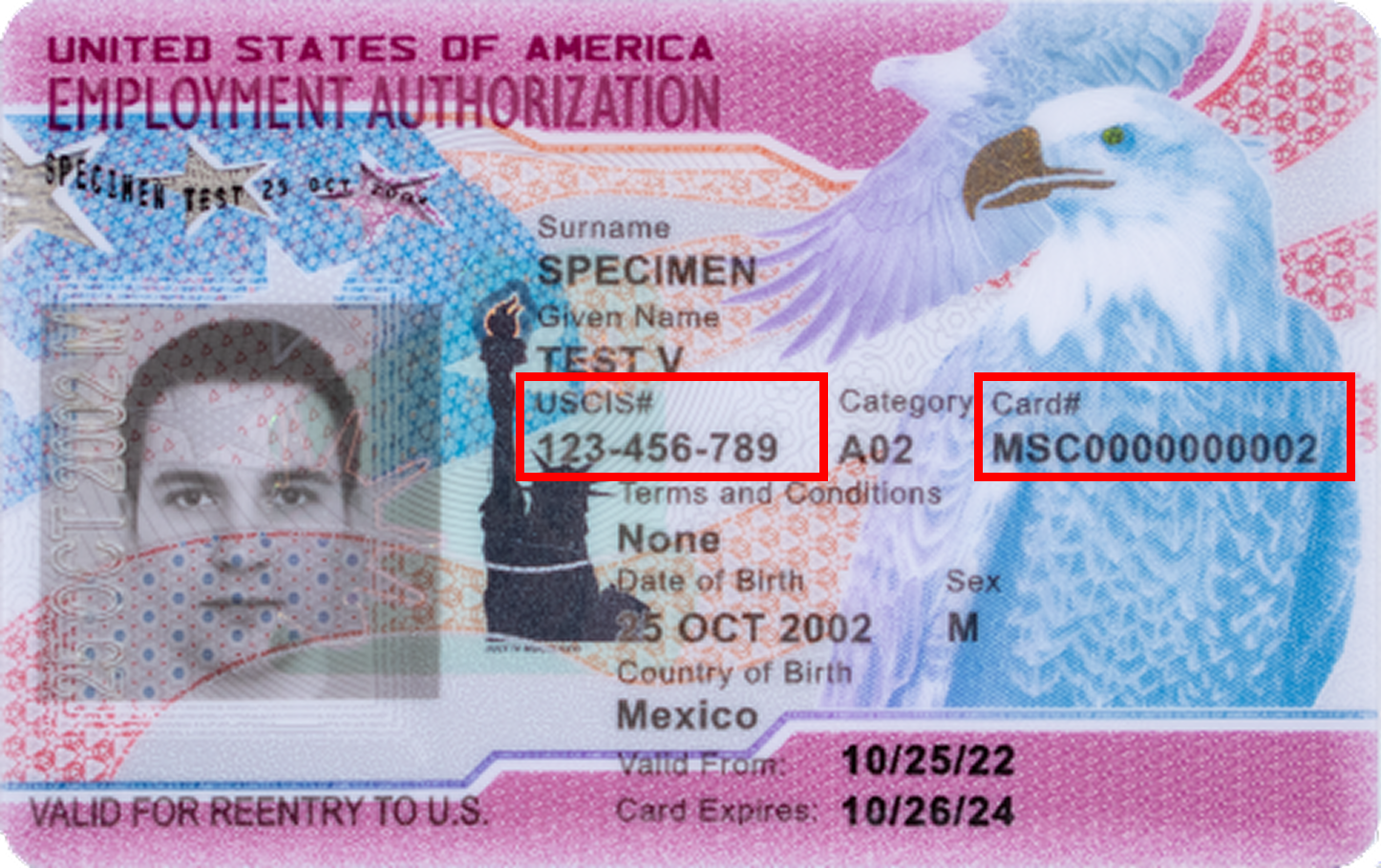
The easiest one to make is putting the USCIS number in the Section 2 Document Number field. Section 2 takes the Card Number, and the USCIS number belongs to Section 1.
The expensive one is treating an EAD like a green card and letting the date pass because the employee has been with you for years. Continuing to employ someone after their work authorization expires without reverifying can bring knowing-employment penalties of $716 to $28,619 per worker, far above the $288 to $2,861 per form for paperwork violations (28 CFR 85.5; see 2026 I-9 penalties). The overcorrection shows up too, usually as a request for a license alongside a valid EAD. And a Social Security card marked "Valid for work only with DHS authorization" can't serve as List C at all (M-274, Section 13.3), so that employee needs another document, often the EAD itself. More in valid for work only with DHS authorization.
An Employment Authorization Document (Form I-766) is the card USCIS issues to show a noncitizen may work in the United States for a set period. On Form I-9, an unexpired EAD with a photo is List A document #4.
It proves the holder can work in the U.S. until the "Card Expires" date. Employers accept it alone for Form I-9, and it also carries the USCIS number the employee uses in Section 1.
Yes. "Work permit" is the common name for the same USCIS card.
No. A green card shows permanent resident status and is never reverified, while an EAD shows temporary permission to work and gets reverified every time it expires.
You file Form I-765, Application for Employment Authorization, with USCIS. USCIS generally recommends filing up to 180 days before the current card expires, and that lead time matters more now that most renewals filed on or after October 30, 2025 don't get an automatic extension.
Only until the card expires, for most renewals filed on or after October 30, 2025. Exceptions come from law or a Federal Register notice, such as those for TPS, and some renewals filed before that date still carry an extension of up to 540 days.
It's the Card Number printed on the front of Form I-766, and it goes in the Section 2 Document Number field. The USCIS number (USCIS#) on the same card goes in Section 1.
List A, document #4, which means it covers identity and work authorization on its own. The full I-9 documents list shows where it sits next to the other options.
Reverify on or before the expiration date in Supplement B. The employee chooses what to show, whether a new EAD, another List A document, or a List C document, and you record it in the next open block of the supplement.
C08 is a pending asylum application and C09 is a pending adjustment of status (green card application). Both are List A EADs, neither one is a green card, and a C08 card can end early if the asylum case is denied.
If your team keeps putting the USCIS number in Section 2, that's a quick fix with the right training, and it's worth doing before an audit finds it. Book a free compliance call and we'll go through it with you.
Call us at (713) 668-6200 (Mon–Fri, 8 AM – 5 PM CT), email support@i-9intelligence.com, or submit a ticket.
To see your overall exposure, try the I-9 Risk Calculator.