
Does a USCIS A-Number Change? What Actually Changes on New Cards
Read the article

If you sponsor H-1B workers, E-Verify may or may not be required for your company — but understanding exactly when and how it applies is critical. E-Verify is not triggered by H-1B sponsorship itself. It is triggered by your state, your contracts, or your voluntary enrollment. The confusion between these triggers is where H-1B employers make costly mistakes.
Sponsoring H-1B workers comes with a separate I-9 workflow your immigration attorney does not handle — see the H-1B I-9 compliance gap for the operational specifics on the 240-day rule, AC-21 portability, and cap-gap.
This guide explains the specific E-Verify rules that affect H-1B sponsors: when enrollment is mandatory, how E-Verify works differently for foreign national employees, and the five mistakes that generate the most penalties.
No. Sponsoring H-1B workers does not, by itself, require an employer to enroll in E-Verify. The H-1B visa petition process (Labor Condition Application, I-129 filing, USCIS adjudication) is completely separate from E-Verify.
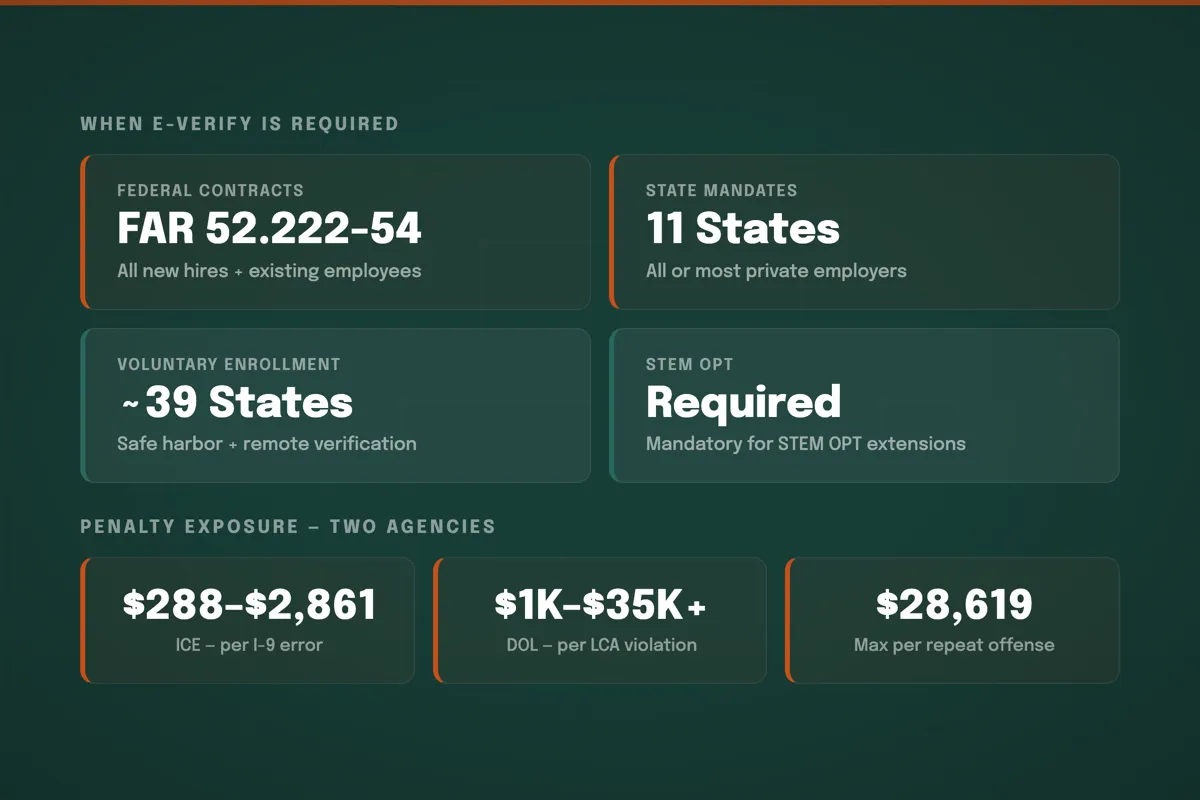
E-Verify enrollment is triggered by three things:
The bottom line: Check your state and your contracts. H-1B sponsorship alone does not create an E-Verify obligation, but many H-1B sponsors are already required to use E-Verify for other reasons.
E-Verify applies the same core process to every new hire — the employer submits information from Form I-9, and the system compares it against government records. But several rules affect foreign national employees differently:
On Form I-9, the employee's Social Security number (SSN) is optional unless the employer participates in E-Verify. For E-Verify employers, the SSN is required. Most H-1B workers have an SSN — it is typically issued during their initial status or applied for shortly after arrival. However, some new H-1B arrivals may not yet have received their SSN. In that case, employers should contact E-Verify directly for guidance rather than delaying the I-9 completion.
When an employee presents certain documents for Section 2 — including a Permanent Resident Card (I-551), an Employment Authorization Document (EAD), or a U.S. passport or passport card — E-Verify may display a photo for the employer to compare against the employee's physical document. This is the photo matching step.
The employer compares the photo displayed by E-Verify to the photo on the employee's document. They do not compare the E-Verify photo to the employee's face. If the photos match, the employer selects "Yes." If they do not match, the employer selects "No," and E-Verify may issue a mismatch result that the employee can contest.
Employers must never ask an employee to present a specific document that triggers photo matching. The employee always chooses which acceptable documents to present.
For E-Verify employers, if the employee presents a List B (identity) and List C (employment authorization) document combination, the List B document must contain a photograph. This eliminates certain identity documents — such as birth certificates used as identity documents for minors — that might otherwise be acceptable on Form I-9 alone. For most H-1B workers presenting a state driver's license or ID card as List B, this rule has no practical impact.
This is the rule that trips up H-1B employers more than any other. When a foreign worker's employment authorization expires — whether from H-1B expiration, EAD expiration, or a status change — the employer must reverify on Supplement B of Form I-9. E-Verify may not be used for reverification. It is only for initial verification of new hires.
Creating an E-Verify case during reverification violates E-Verify program rules. The reverification happens entirely on Supplement B — examine the employee's new unexpired document, record it, sign and date.
E-Verify cases must be created no later than the third business day after the employee's first day of work for pay. This is the same deadline as Section 2 completion and applies to every new hire, including H-1B workers. Late E-Verify case creation is a program violation even if the underlying I-9 was completed on time.
Managing I-9 and E-Verify for sponsored workers? Use our free I-9 Risk Calculator to assess your compliance exposure, or talk to our compliance team about your specific situation.
H-1B sponsors operate in every state, but the E-Verify landscape varies dramatically. Here is a summary of how state mandates interact with H-1B sponsorship:
If you operate in any of these states, E-Verify is required regardless of whether you sponsor H-1B workers:
| State | Threshold | Key Detail |
|---|---|---|
| Alabama | All employers | Beason-Hammon Act, effective 2012 |
| Arizona | All employers | License suspension/revocation for violations |
| Florida | 25+ employees | SB 1718 (2023). Expansion bills died in 2025 session |
| Georgia | 10+ employees | |
| Mississippi | All employers | |
| Montana | All employers (or document retention alternative) | LEGAL Act (HB 226), effective July 2025 |
| North Carolina | 25+ employees | |
| South Carolina | All employers | |
| Tennessee | 50+ employees (private) | Smaller employers may use E-Verify or collect documents |
These states require E-Verify for state contractors — relevant if your company bids on state or local government work:
Colorado, Idaho, Indiana, Louisiana, Michigan, Minnesota, Missouri, Nebraska, Oklahoma, Pennsylvania, Texas, Utah, Virginia, West Virginia
Note on Indiana: Indiana's regulatory landscape changed on March 5, 2026, when Governor Braun signed the FAIRNESS Act (Senate Enrolled Act 76). Effective July 1, 2026, the law applies to all Indiana employers — not just state contractors — and makes E-Verify the primary safe harbor against state-level penalties up to $10,000. H-1B sponsors with Indiana operations need to enroll in E-Verify for all Indiana hires, regardless of whether they hold state contracts. See our Indiana FAIRNESS Act compliance guide.
Two states restrict private employers from mandating E-Verify use beyond what federal law requires:
The remaining states have no E-Verify mandate for private employers. Federal contractor rules and voluntary enrollment still apply.
"H-1B sponsors in states like California sometimes assume E-Verify doesn't apply to them at all. But if they hold a single federal contract with the FAR clause, they are required to use it for every new hire — not just the contract employees. That catches people off guard."
— Patricia, Director of Compliance at i9 Intelligence, 14 years of I-9 and E-Verify experience
One scenario where E-Verify enrollment is directly tied to foreign worker employment: STEM OPT extensions require the employer to be enrolled in E-Verify. If you employ an F-1 student on a STEM OPT extension, your company must participate in E-Verify as a condition of that employment.
This affects H-1B sponsors because many H-1B workers started as OPT or STEM OPT employees before their H-1B petition was filed. If you enrolled in E-Verify to comply with STEM OPT requirements, you must continue using E-Verify for all new hires — you cannot selectively verify only STEM OPT employees.
When an H-1B extension is approved or an EAD is renewed, some employers create a new E-Verify case. This is a violation. Reverification happens on Supplement B of Form I-9 only. No E-Verify case is created.
An employer enrolled in E-Verify must create a case for every new hire — not just foreign workers. Running E-Verify only on H-1B employees and skipping domestic hires is discriminatory and violates both E-Verify program rules and anti-discrimination law (8 U.S.C. 1324b).
E-Verify cases cannot be created before the employee has accepted a job offer and completed Section 1 of Form I-9. Pre-screening applicants through E-Verify — even unintentionally — is prohibited.
When E-Verify returns a Tentative Nonconfirmation, the employer must notify the employee within 10 federal working days and allow them to contest the finding. An employer cannot fire, suspend, reduce hours, or take any adverse action against the employee while the TNC is being resolved. For H-1B workers, a TNC can be particularly alarming — but it does not mean the employee is unauthorized. Data entry errors, name mismatches, and pending status updates all trigger TNCs.
Every E-Verify case generates a case verification number. Best practice is to record this number in the Additional Information field of Section 2 on Form I-9. During an ICE audit or E-Verify site visit, the employer must be able to show that cases were created for all required employees within the three-day window. Without case numbers tied to I-9s, proving compliance is significantly harder.
H-1B sponsors already manage LCA compliance (prevailing wage, worksite posting, public access file) through the Department of Labor. Form I-9 and E-Verify add a second compliance track through the Department of Homeland Security and ICE.
These tracks do not communicate. A perfectly compliant LCA filing does not protect you from I-9 or E-Verify violations. And a clean E-Verify record does not help if your LCA paperwork is incomplete. For H-1B sponsors, compliance means managing both — and connecting the workflow so that every approved petition triggers both the immigration follow-up and the employment verification process.
| Obligation | Agency | Penalty Range | Applies To |
|---|---|---|---|
| LCA violations | DOL (WHD) | $1,000–$35,000+ per violation | Prevailing wage, worksite posting, public access file |
| I-9 violations | ICE | $288–$2,861 per paperwork error; up to $28,619 per repeat offense | Form completion, document examination, retention |
| E-Verify violations | DHS | Debarment, contract termination, referral to ICE | Case creation, timing, program rules |
| Knowingly employing unauthorized worker | ICE | $698–$28,619 per worker (criminal penalties possible) | All employers |
No. E-Verify is not a requirement of the H-1B visa petition process. Employers may be required to use E-Verify based on their state, their federal contracts, or their own voluntary enrollment — but H-1B sponsorship alone does not trigger an E-Verify obligation.
No. If you are enrolled in E-Verify, you must create a case for every new hire, regardless of citizenship or visa status. Selectively using E-Verify for foreign workers is discriminatory and violates both E-Verify program rules and federal anti-discrimination law.
Yes. Employers who employ F-1 students on STEM OPT extensions must be enrolled in E-Verify. This is a condition of the STEM OPT program, not a general E-Verify requirement. Once enrolled, you must use E-Verify for all new hires.
A Tentative Nonconfirmation does not mean the employee is unauthorized. Notify the employee within 10 federal working days, let them know their rights, and allow them to contest the finding. Do not take adverse employment action during the resolution process. Many TNCs are resolved through data corrections at SSA or DHS.
You can create an E-Verify case after the employee accepts a job offer, completes Section 1, and you have completed Section 2. You cannot run E-Verify as a pre-employment screening tool. The case must be created no later than three business days after the first day of work for pay.
i9 Intelligence provides I-9 compliance software with built-in E-Verify integration, automated case creation, reverification tracking, and remote Section 2 verification — designed for employers managing complex immigration workforces.