
Does a USCIS A-Number Change? What Actually Changes on New Cards
Read the article

Every Labor Condition Application (LCA) your company files means at least one foreign worker who needs a completed Form I-9 and, in many cases, an E-Verify case. Most employers treat these as separate workstreams — immigration counsel handles the LCA and visa petition, while HR handles employment verification. That disconnect is where compliance failures happen.
This guide connects the two. If you file LCAs for H-1B, H-1B1, or E-3 workers, here is everything you need to know about the Form I-9 and E-Verify obligations that come with them. For the five operational moments where H-1B I-9 errors happen most — extensions, portability, cap-gap, reverification — see the H-1B I-9 compliance breakdown.
A Labor Condition Application (Form ETA-9035) is a filing that employers must submit to the U.S. Department of Labor (DOL) before petitioning U.S. Citizenship and Immigration Services (USCIS) for an H-1B, H-1B1, or E-3 worker. The LCA certifies that the employer will:
The DOL reviews and certifies the LCA — typically within 7 business days — before the employer can file the I-129 petition with USCIS. LCA filings are public records. The DOL's Office of Foreign Labor Certification publishes disclosure data quarterly, covering every certified LCA in the country.
The LCA is an immigration law obligation. But every worker covered by an LCA is also subject to employment verification law — and that is where Form I-9 and E-Verify come in.
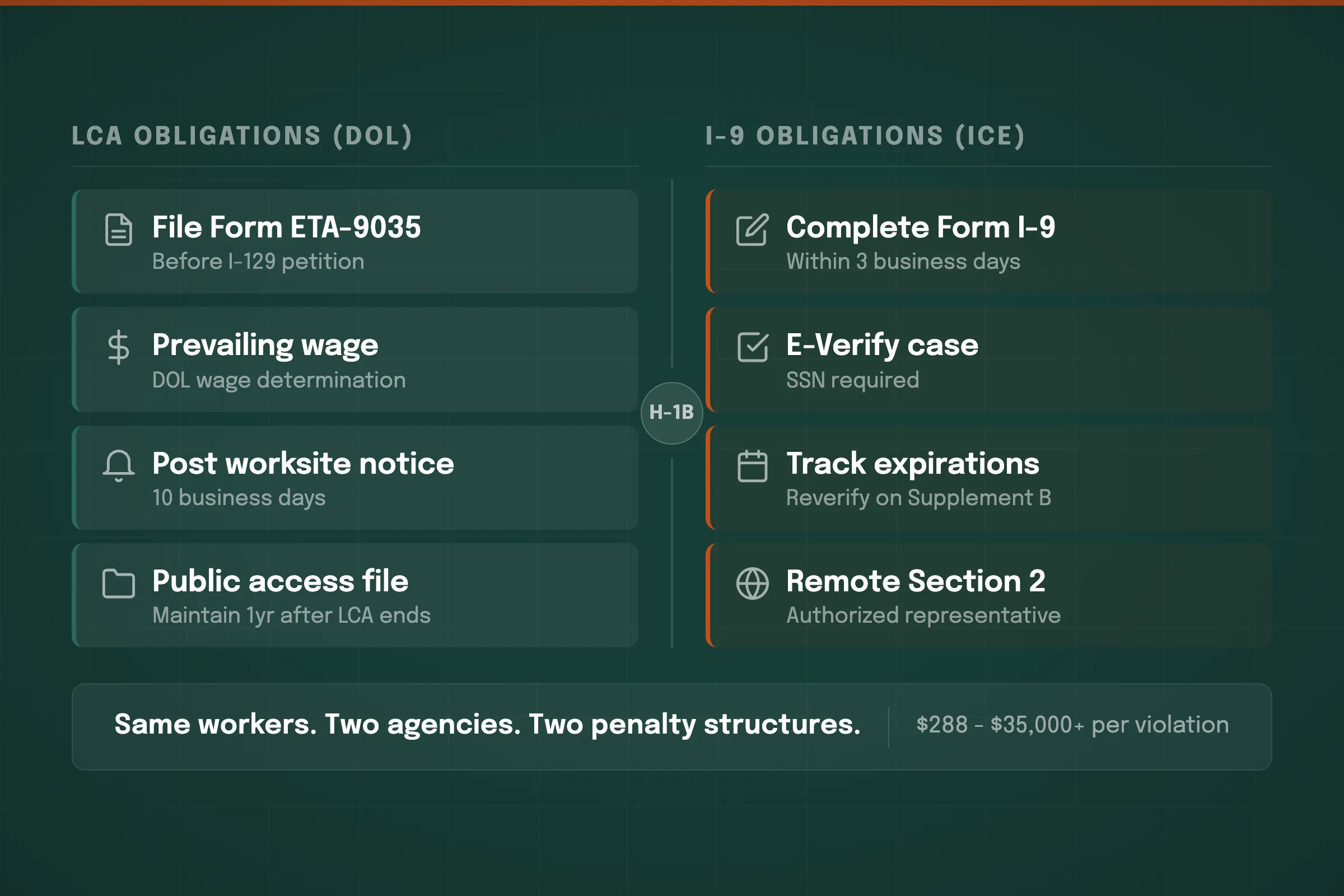
Here is the connection that most compliance guides miss: the same worker who triggers an LCA filing also triggers Form I-9 requirements. These are separate federal obligations, enforced by separate agencies (DOL for LCA, U.S. Immigration and Customs Enforcement for I-9), with separate penalty structures. An employer can be fully compliant on the immigration side and still face fines for I-9 violations — or vice versa.
Form I-9 applies to every employee hired after November 6, 1986, regardless of citizenship or visa status. That includes every H-1B, H-1B1, and E-3 worker. There are no exceptions.
For H-1B workers specifically, the I-9 process involves several details that differ from domestic hires:
This is the combined checklist that covers both sides of the compliance equation — the LCA obligations your immigration counsel manages and the I-9/E-Verify obligations your HR team owns.
Managing I-9s for H-1B workers? Talk to a compliance expert — call (713) 668-6200.
1. Asking for specific documents. An employer cannot tell an H-1B worker which documents to present for Section 2. The employee chooses from the Lists of Acceptable Documents. Requesting a specific document — even if it seems logical for a visa holder — is document abuse and constitutes an unfair immigration-related employment practice under 8 U.S.C. 1324b.
2. Using E-Verify for reverification. E-Verify may only be used at the time of initial hire. It cannot be used to reverify an employee’s work authorization when it expires. This mistake is common because it feels intuitive — but USCIS is explicit: reverification happens on Supplement B, not in E-Verify.
3. Missing the 3-business-day deadline. Section 2 must be completed within three business days of the employee’s first day of work for pay. For H-1B workers who start remotely or at a different location, this deadline still applies. If the employee is not physically present, an authorized representative must examine documents on the employer’s behalf — or the employer must use the DHS-authorized remote examination procedure.
4. Not tracking expiration dates. H-1B authorizations expire. EADs expire. When an employer has dozens or hundreds of H-1B workers across multiple locations, tracking every expiration date manually is where compliance breaks down. A single missed reverification can result in a fine.
5. Treating LCA and I-9 compliance as separate workflows. The immigration attorney files the LCA. HR handles the I-9. Neither team talks to the other. The result: the LCA public access file is maintained while the Form I-9 is incomplete, or the I-9 is perfect but the LCA notice posting was missed. Both are compliance obligations for the same worker.
“The most common issue we see with H-1B employers is expiration tracking,” said Patricia, Director of Compliance at i9 Intelligence with 27 years of I-9 and E-Verify experience. “The employer files the petition, the worker starts, the I-9 gets done on day one — and then nobody tracks the expiration date. Two years later, the authorization expires and the reverification never happens. That is a violation for every single day the employee continues working without a current I-9.”
Employers who sponsor foreign workers face two separate penalty frameworks. A compliance failure involving an H-1B worker can trigger enforcement from both the DOL (for LCA violations) and ICE (for I-9 violations). These are independent — one agency’s finding does not require the other to act, but both can investigate the same employer at the same time.
| Violation Type | LCA Penalties (DOL) | I-9 Penalties (ICE) |
|---|---|---|
| Paperwork / technical violations | $1,000–$5,000 per violation | $288–$2,861 per Form I-9 |
| Substantive violations | $5,000–$15,000 per violation | $716–$5,724 per unauthorized worker (first offense) |
| Willful / repeat violations | $15,000–$35,000+ per violation | $8,586–$28,619 per worker (third+ offense) |
| Document fraud / abuse | Debarment from H-1B program (1+ years) | $573–$2,292 per individual |
| Enforced by | DOL Wage and Hour Division | U.S. Immigration and Customs Enforcement |
| Investigation trigger | DOL complaint, WHD audit | ICE Notice of Inspection (NOI), I-9 audit |
I-9 penalty amounts reflect the January 2025 inflation adjustment under 8 CFR 274a.10. LCA penalty ranges are from INA 212(n)(2).
Consider the math: an employer with 50 H-1B workers and a 10% I-9 error rate (5 defective forms) faces $1,440 to $14,305 in I-9 paperwork fines alone. If those same workers also have LCA notice-posting deficiencies, add $5,000 to $25,000 in DOL penalties. Two agencies, two investigations, one employer.
For employers managing more than a handful of H-1B workers, the operational complexity of tracking authorization dates, reverification deadlines, and E-Verify cases across locations is where manual processes fail. I-9 compliance software addresses this by:
Not necessarily. If the employee is continuing with the same employer and their work authorization has not expired, you do not need a new Form I-9. However, if their employment authorization document (such as an EAD) expires, you must reverify on Supplement B by recording new, unexpired documentation. If there is a gap in employment or the employee is considered a new hire, a new Form I-9 is required.
No. E-Verify may only be used at the time of initial hire. Reverification is completed on Supplement B of Form I-9 by examining new List A or List C documents. Using E-Verify for reverification violates program rules.
The employee chooses which documents to present from the Lists of Acceptable Documents. Common documents H-1B workers present include a foreign passport with a Form I-94 (List A), an Employment Authorization Document (List A), or a combination of a foreign passport (List B) with an employment authorization document (List C). The employer may not request specific documents.
No. E-Verify participation is not required to file an LCA or sponsor an H-1B worker. However, E-Verify is mandatory for certain employers — including federal contractors and employers in states with E-Verify mandates. If you participate in E-Verify, you must create a case for every new hire, including H-1B workers.
The LCA certification and Form I-9 compliance are independent obligations enforced by different agencies. A certified LCA does not protect you from I-9 penalties, and a clean I-9 audit does not prevent DOL from investigating LCA violations. Both must be maintained separately for the same workers.
Need help managing I-9 compliance for your H-1B workforce? i9 Intelligence provides I-9 software with automated E-Verify integration and remote Section 2 verification — built for employers who sponsor foreign workers.
Call: (713) 668-6200 (Mon–Fri, 8am–5pm CT)
Email: support@i-9intelligence.com
Submit a ticket: https://www.i-9intelligence.com/submit-a-ticket