
How Much Does Remote I-9 Verification Cost? 2026 Prices Compared
Read the article

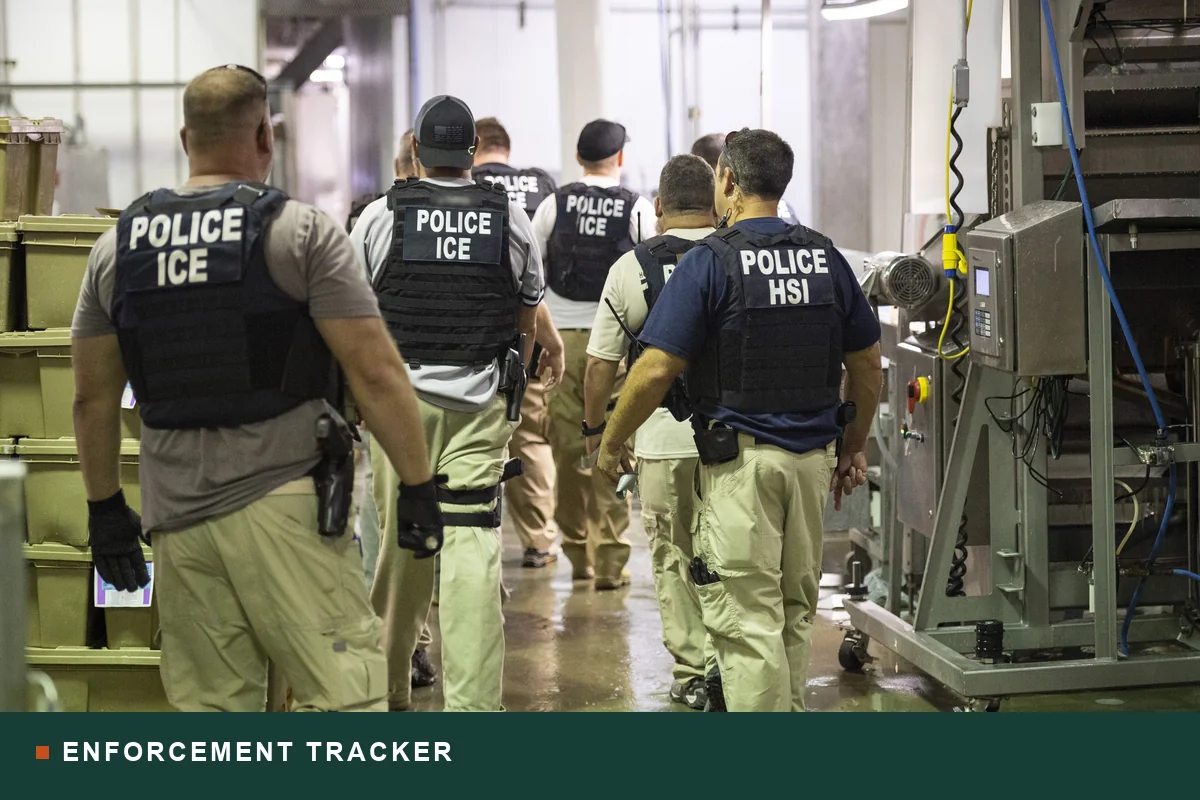
Worksite enforcement in 2026 has moved from the raid to the paperwork. ICE set three straight monthly arrest records this summer (50,925 in August, per DHS), but that surge came mostly from street arrests and local-jail cooperation. The biggest single-site worksite raids in this tracker are still from 2025. The tools pointed at employers in 2026 are paperwork tools. In March, ICE made more than 10 common Form I-9 errors immediately fineable. In July, Border Czar Tom Homan described a plan to run I-9 audits at scale with contractors. In August, ICE quietly tightened how its audits run.
This tracker compiles the major enforcement actions, court rulings, policy changes, and fines since early 2025, each linked to its source. If you manage Form I-9 compliance, the practical takeaway for 2026 is that a Notice of Inspection is the enforcement action most employers should plan for.
These developments matter more to an HR team than any single raid.
The March 16 fact sheet made common mistakes expensive. ICE's revised Form I-9 Inspection fact sheet moved more than 10 error types, including a missing date of birth, a missing hire date, and an undated Section 1 or Section 2, from "technical" (10 business days to correct) to "substantive" (fineable on inspection). No Federal Register notice was issued. Holland & Knight called it a significant departure from the 1997 Virtue Memorandum, the framework ICE and the administrative hearing office had relied on for nearly 30 years, and Morgan Lewis noted it eliminates the inspection-time cure window for every reclassified error.
ICE revised the fact sheet again on August 31, without an announcement. Every March reclassification still stands. The August version adds a "compliant audit trail" requirement for electronic I-9s, says warning notices "will not" issue for repeat or uncorrected cases, calculates fines separately by category, and requires hearing requests to be received by ICE within 30 days. The change with the most money behind it is a new notice telling employers, mid-audit, which workers have lost work authorization. Keeping those workers on after the notice arrives is the knowing-hire exposure in the penalty table below.
The administration says audit volume is going up. In a July 2026 interview with the Center for Immigration Studies, Homan described a centralized operation, staffed by contractors, that would review employers' I-9 records in bulk and refer administrative and criminal red flags to Homeland Security Investigations (HSI). He also described closer coordination among ICE, the IRS, the Social Security Administration (SSA), the Department of Labor (DOL), and the Department of Justice (DOJ). Holland & Hart and WR Immigration both note the plan has no timetable and hasn't been formally adopted. If it happens, far more employers get an NOI in a year than HSI agents alone could serve.
The data-sharing story is narrower than the headlines. The IRS arrangement with ICE covered individual taxpayers' last-known addresses, not employer payroll records, and on September 8 the D.C. Circuit affirmed the injunction blocking it. DHS's request for the National Directory of New Hires is still unresolved, and the next two sections cover both.
Over-documentation is being enforced too. In June, DOJ's Immigrant and Employee Rights Section (IER) settled with Whirlpool over an electronic I-9 system at its Amana, Iowa plant that allegedly prompted HR to ask non-U.S. citizens for unnecessary documents at reverification and to reverify expired green cards and List B IDs. Whirlpool denies the allegations and agreed to $125,000 in civil penalties plus up to $100,000 in back pay. An I-9 system configured to over-ask creates its own liability.
The errors ICE reclassified in March are the ones a bulk reviewer finds first. Missing dates and blank fields are easy to spot at scale. Run our I-9 Risk Calculator for a rough exposure number, or schedule a free compliance call and we'll walk through where your forms are likely to fail.
On April 7, 2025, ICE and the IRS signed a memorandum of understanding that let ICE request taxpayers' last-known addresses for people under criminal investigation for remaining in the U.S. after a final order of removal. In June 2025, ICE asked for addresses on 1.28 million people.
What this means for employers: this arrangement was built to find people, not to audit payrolls. It didn't hand ICE a list of employers with W-2 mismatches, and the procedure is blocked while the case continues. The employer-side risk from federal data is the coordination Homan described, which is a direction of travel rather than a live audit trigger today. Name and Social Security number mismatches still matter, though. SSA stopped mailing "no-match" letters in April 2021, and employers now see W-2 name/SSN errors only if they check SSA's Business Services Online portal. A mismatch is not proof someone lacks work authorization, and acting on one without a process is an IER problem.
In March 2026, DHS asked HHS for access to the Federal Parent Locator Service, the child-support database whose National Directory of New Hires holds names, addresses, Social Security numbers, employers, and wages for nearly every employed person in the country. It also includes the Federal Case Registry, which contains sensitive family and domestic-violence information.
Federal law, 42 U.S.C. § 653, limits the database to child-support, parentage, and custody purposes, and immigration enforcement isn't on the list. On April 14, 2026, Senate Finance Committee Ranking Member Ron Wyden and Senator Sheldon Whitehouse asked HHS to put its legal position in writing. As of that reporting, the request was under review in HHS's general counsel's office, and we haven't found a public decision since.
Why employers should care anyway: the new-hire data comes from the new-hire reports employers already file with their states. If DHS gets access, the gap between who is on your payroll and who has a clean Form I-9 becomes much easier for the government to see.
I-9 exposure for visa sponsors now comes from several agencies at once. USCIS's Fraud Detection and National Security (FDNS) unit conducts unannounced site visits to confirm that an H-1B worker actually works at the listed location, performs the described duties, and receives the stated salary. Discrepancies found on those visits can lead to a full I-9 inspection. For the overlap between labor condition applications and I-9s, see our LCA and I-9 compliance checklist.
On September 8, DOL's Office of Inspector General announced it had suspended new PERM labor-certification filings for two technology employers as part of its H-1B and PERM fraud investigation; no criminal charges had been filed as of the September reporting (see what the PERM freeze means for I-9s). On September 18, the President extended the $100,000 H-1B payment under Proclamation 10973 through September 21, 2027, and signed an executive order directing closer interagency review of H-1B petitions, labor condition applications, and visas, including an employer's recent layoffs. The payment itself remains blocked by court order (details in our H-1B fee guide). On October 8, Labor Secretary Keith Sonderling widened the PERM suspensions to eight companies, including Microsoft and Adobe, and to pending applications as well as new ones, while the Inspector General announced J-1 visa subpoenas to nine universities (our October PERM suspension guide covers both).
For sponsors, an I-9 inspection still needs only a Notice of Inspection, with no warrant and no probable cause, so it's the lowest-friction way for any of these agencies' findings to turn into fines. Technology, consulting, healthcare, and engineering employers that never thought of themselves as worksite-enforcement targets should treat the I-9 file with the same care as the petition file.
These are enforcement actions, rulings, and policy changes confirmed by federal agencies, court records, or verified news reports, newest first. The Result column gives the outcome where it's known.
| Date | Location | Action | Result |
|---|---|---|---|
| Oct 8, 2026 | Nationwide | Labor Secretary suspends eight employers from PERM (Cognizant, Infosys, Tata Consultancy Services, Wipro, HCL Technologies, Capgemini, Microsoft, Adobe), covering new and pending applications | No charges announced; duration and legal authority not published |
| Oct 8, 2026 | Nine universities | DOL Inspector General opens J-1 visa investigations into Harvard, Yale, Stanford, Brown, Pittsburgh, UC Davis, Caltech, Arizona State, and MIT over federally funded research positions | Subpoenas served; no charges |
| Sep 18, 2026 | Nationwide | Proclamation 10973 extended through Sep 21, 2027; separate executive order directs interagency review of H-1B petitions, LCAs, and visas, including recent layoffs | $100,000 payment still uncollectable under the California v. Mullin vacatur |
| Sep 8, 2026 | Washington, D.C. | D.C. Circuit affirms injunction blocking the IRS procedure for disclosing taxpayer addresses to ICE | 47,289 records disclosed before the stay; further disclosures barred except in strict compliance with § 6103 |
| Sep 8, 2026 | Nationwide | DOL OIG suspends new PERM filings for two technology employers in its H-1B and PERM fraud investigation | No criminal charges filed as of September reporting |
| Aug 31, 2026 | Nationwide | ICE revises its Form I-9 Inspection fact sheet a second time, without announcement: compliant audit trail for electronic I-9s, a new mid-audit notice of expired or rescinded work authorization, and warning notices that "will not" issue for repeat or uncorrected cases | No new reclassifications; hearing requests must now be received by ICE within 30 days |
| Jun–Aug 2026 | Nationwide | ICE sets three straight monthly arrest records: 43,900 (June), 50,208 (July), 50,925 (August), per DHS | Driven by street arrests, 287(g) agreements, and jail detainers rather than high-profile operations, per the Deportation Data Project |
| Jul 2026 | Nationwide | Border Czar Tom Homan describes a centralized, contractor-staffed I-9 audit operation and closer ICE coordination with IRS, SSA, DOL, and DOJ | Proposal only; no timetable or formal adoption announced |
| Jul 1, 2026 | Indiana | FAIRNESS Act (SEA 76) takes effect for all Indiana employers | Court-ordered suspension or revocation of Indiana operating authority; attorney general enforces through civil investigative demands; E-Verify use is a safe harbor |
| Jul 1, 2026 | Iowa | SF 2218 takes effect, requiring E-Verify for public employers and adding a civil penalty for private employers who knowingly hire someone using a false Social Security number | $10,000 civil penalty; enforced by Iowa Workforce Development |
| Jun 2026 | Amana, IA | DOJ IER settlement with Whirlpool over electronic I-9 system prompts that allegedly required unnecessary documents at reverification and reverified expired green cards and List B IDs | $125,000 civil penalties plus up to $100,000 back pay; three-year compliance terms; Whirlpool denies the allegations |
| Apr 14, 2026 | Washington, D.C. | Senators Wyden and Whitehouse press HHS on DHS's request for the Federal Parent Locator Service | Request under HHS general counsel review; no public decision reported |
| Apr 7, 2026 | St. Peters, MO | OCAHO approves settlement of ICE's complaint against Industrial Construction and Engineering Co.: Section 1, 2, or 3 errors on 62 forms and 27 forms never prepared or presented | Original Notice of Intent to Fine sought $214,133.30; company admitted the paperwork violations and agreed to a civil penalty |
| Mar 19, 2026 | Ohio | Ohio E-Verify Workforce Integrity Act takes effect for nonresidential construction contractors, subcontractors, and labor brokers | Fines up to $25,000 per violation; permanent license revocation for knowingly hiring unauthorized workers |
| Mar 16, 2026 | Nationwide | ICE revises its Form I-9 Inspection fact sheet, reclassifying errors such as missing date of birth, missing hire date, undated Sections 1 or 2, missing rehire date, Spanish-language I-9 use outside Puerto Rico, preparer/translator errors, and missing employer title as substantive | No 10-day correction window for these errors; fines can be assessed on inspection |
| Mar 2026 | Nationwide | DHS requests access to the Federal Parent Locator Service, including the National Directory of New Hires | Federal law limits the database to child-support purposes |
| Feb 23, 2026 | Nationwide | DHS publishes a proposed rule on work authorization for asylum applicants (Employment Authorization Documents, or EADs) | Proposed only; would extend the wait to apply for an asylum-based EAD to 365 days and pause new applications while asylum processing runs past 180 days |
| Feb 2026 | Washington, D.C. | HSI sends "notice of suspect documents" letters to D.C. restaurants following May 2025 I-9 inspections | At least 131 workers lost employment across multiple restaurants |
| Jan–Mar 2026 | Shakopee, MN | Three ICE visits to D.R. Horton construction sites | Workers reported being questioned; investigation ongoing |
| Jan 11–19, 2026 | El Paso, TX, and Santa Teresa, NM | Nine-day operation at three construction sites | 38 workers arrested; three minors ages 15 to 17 found working on the sites |
| Jan 2026 | Nationwide | ICE adds 12,000+ new officers through a four-month recruitment campaign (120% workforce expansion) | Largest personnel increase in agency history |
| Date | Location | Action | Result |
|---|---|---|---|
| Nov 2025 | Washington, D.C. | Federal district court stays the IRS procedure for sending taxpayer addresses to ICE (Center for Taxpayer Rights v. IRS) | Further disclosures halted; affirmed by the D.C. Circuit in September 2026 |
| Sep 4, 2025 | Ellabell, Bryan County, GA | Raid at Hyundai Motor Group Metaplant America (EV battery plant), executed on a criminal search warrant | 475 workers detained, the largest single-site enforcement operation in DHS history |
| Jul 10, 2025 | Camarillo and Carpinteria, CA | Operation at two cannabis cultivation facilities | 361 workers arrested; one farmworker died after a fall |
| Jun 2025 | Vinton, LA | Worksite raid at Delta Downs racetrack | 84 workers arrested |
| May 29, 2025 | Tallahassee, FL | Construction site enforcement operation | 100+ workers arrested |
| May 2025 | Washington, D.C. | I-9 inspections at 100+ restaurants and food businesses | Notices of Inspection served; suspect-document letters followed in February 2026 |
| May 2025 | Wildwood, FL | Construction site enforcement operation | 33 workers arrested |
| Apr 7, 2025 | Nationwide | ICE–IRS memorandum of understanding signed | Lets ICE request taxpayers' last-known addresses; procedure later blocked in court |
| Employer | Location | Amount | Violation Type |
|---|---|---|---|
| Whirlpool, LLC (2026, DOJ IER) | Amana, IA | $125,000 civil penalties + up to $100,000 back pay | Alleged unfair documentary practices during reverification (8 U.S.C. § 1324b); denied by the company |
| Industrial Construction and Engineering Co. (2026, OCAHO) | St. Peters, MO | $214,133.30 sought in the Notice of Intent to Fine; settled | Paperwork violations only: incomplete Sections 1–3 and forms not prepared or presented |
| CCS Denver, Inc. (2025, commercial cleaning) | Denver, CO | $6.18 million | I-9 violations, knowingly employing unauthorized workers |
| PBC Commercial Cleaning Systems, Inc. (2025) | Denver, CO | $1.6 million | I-9 violations, knowingly employing unauthorized workers |
| Green Management Denver (2025) | Denver, CO | $270,000 | I-9 violations, employing unauthorized workers |
The Industrial Construction case is the one most HR teams should read. There was no allegation of knowingly hiring anyone. A six-figure proposed fine came entirely from forms that were incomplete or couldn't be produced.
Know of an enforcement action we're missing? Contact us and we'll verify and add it.
ICE doesn't publish how it selects employers for inspection. Based on enforcement patterns, published legal advisories, and reported cases, these are the factors most often cited:
Federal data coordination is the one to watch rather than plan around. Homan has described closer ICE coordination with the IRS, SSA, DOL, and DOJ, but the IRS address procedure is blocked in court and the new-hires database request is unresolved.
For a detailed breakdown, see What Triggers an I-9 Audit?
The current amounts were set by the January 2, 2025 inflation adjustment. DHS did not publish a 2026 adjustment, so the 2025 figures remain in force for violations assessed in 2026.
For failing to properly complete, retain, or produce Form I-9, the fine is $288 to $2,861 per form. It applies to substantive violations and to technical or procedural errors the employer doesn't correct within the 10-business-day window after ICE gives notice. Since March 16, 2026, that window no longer covers missing dates of birth, missing hire dates, undated Sections 1 or 2, Spanish-language I-9s used outside Puerto Rico, and the other errors ICE reclassified as substantive.
| Offense | Minimum Fine | Maximum Fine | Per |
|---|---|---|---|
| First offense | $716 | $5,724 | Per unauthorized worker |
| Second offense | $5,724 | $14,308 | Per unauthorized worker |
| Third or more | $8,586 | $28,619 | Per unauthorized worker |
Fifty forms with errors can mean paperwork fines of $14,400 to $143,050 before anyone asks whether a single worker was unauthorized. If some were, the knowing-hire penalties stack on top.
Since August 31, ICE can also put the knowing part in writing. Its new Notice of Expired or Rescinded Immigration Status and/or Employment Authorization tells you during an audit which employees can no longer work, and the fact sheet says an employer who knowingly continues to employ unauthorized workers "must immediately cease the unlawful activity." Our breakdown of the August changes covers what to do when that notice arrives.
For every penalty amount and how ICE calculates fines, see I-9 Penalties in 2026. To find and fix errors before an inspection, use our I-9 Audit Checklist.
Source: 8 CFR § 274a.10, as adjusted under the Federal Civil Penalties Inflation Adjustment Act (January 2, 2025).
The employers who pay the largest fines are usually the ones who first look at their I-9s after the Notice of Inspection arrives, so start before that.
A Notice of Inspection gives you three business days to produce your Forms I-9, and the March fact sheet took away most of the room to fix mistakes after that. Since August, ICE also says it will not issue a warning notice to an employer that has already received a warning notice or a Notice of Intent to Fine. The time to find the missing dates and blank fields is before a reviewer does. Schedule a free compliance call and our compliance team will review your current I-9 process and help you find the gaps.
Phone: (713) 668-6200 (Mon–Fri, 8am–5pm CT)
Email: support@i-9intelligence.com
Ticket: Submit a ticket
An ICE audit, formally a Form I-9 inspection, is when U.S. Immigration and Customs Enforcement reviews an employer's Forms I-9 for compliance with federal employment verification rules. It starts with a Notice of Inspection, and the employer has at least three business days to produce the Forms I-9 for current employees and for former employees still within the retention period.
The most recent public benchmark is from 2025, when Notices of Inspection in the first half of the year ran at least ten times the 2024 rate (about 230 audits for all of 2024). Homan's July 2026 plan for contractor-run reviews is aimed at raising volume well past what HSI agents can handle alone.
Not under the arrangement that's been in the news. The 2025 IRS–ICE agreement covered individual taxpayers' last-known addresses, and the procedure built under it has been blocked by a federal court since November 2025, a ruling the D.C. Circuit affirmed on September 8, 2026. Homan has said ICE wants closer coordination with the IRS and SSA, so that could change, but it isn't how ICE is picking employers today.
Yes. Asking for more or different documents than the rules require, or reverifying documents that don't need it, can be an unfair documentary practice under 8 U.S.C. § 1324b. Whirlpool agreed to $125,000 in civil penalties and up to $100,000 in back pay in June 2026 over electronic I-9 prompts that allegedly did exactly that, while denying the allegations. Over-documenting is not a safe way to be careful.
Paperwork violations run $288 to $2,861 per form. Knowingly hiring or continuing to employ unauthorized workers runs $716 to $28,619 per worker, depending on whether it's a first, second, or later offense. Criminal penalties can apply to a pattern or practice of violations. These are the January 2025 amounts, which remain in force because no 2026 adjustment was published.
Their exposure comes from more directions. USCIS FDNS site visits can surface discrepancies that lead to an I-9 inspection, DOL's Inspector General is running an H-1B and PERM fraud investigation that produced PERM suspensions in September and October 2026, and a September 18 executive order directs closer interagency review of H-1B filings. The I-9 file is the part of that picture an employer fully controls.
Yes. Ohio's mandate for nonresidential construction contractors took effect March 19, 2026. Indiana's FAIRNESS Act took effect July 1, 2026 for all Indiana employers, with E-Verify as the law's safe harbor, which makes it the practical standard for every Indiana employer. Iowa's SF 2218 took effect the same day, requiring E-Verify for public employers and adding a $10,000 penalty for private employers who knowingly hire someone using a false Social Security number. These join existing state mandates in Alabama, Arizona, Mississippi, South Carolina, and others.
Start with a self-audit using our I-9 Audit Checklist, fix errors with proper correction procedures, and check what your electronic I-9 system asks employees for. If you want a second set of eyes, schedule a free compliance call with our team.