
DOL Suspends Microsoft, Adobe, and Six IT Firms From PERM: What It Means for Form I-9
Read the article

Many HR teams end up with Form I-9 records in two places at once — Section 1 captured in their HRIS, the rest stored in a separate compliance system, or some I-9s on paper while new ones go electronic. Federal law doesn't expressly prohibit storing Form I-9s in more than one system, but the rules that govern electronic I-9s collapse quickly when records are split.
The risk shows up the moment ICE issues a Notice of Inspection. You have three business days to produce a complete, defensible record for every employee — every signature, every correction, every reverification, every change of address, every termination — with an unbroken audit trail. If those records live in two systems, you have to prove that each system independently satisfies the federal electronic-I-9 requirements, and that the two together produce one coherent history per employee. Most split setups can't do either.
Two regulatory anchors govern this:
USCIS does permit "a paper system, an electronic system or a combination of paper and electronic systems" to store Form I-9. But the permission is conditional: every system in your setup has to meet the full list of controls on its own, and the combined record has to be retrievable and complete. Retention timing is a separate problem: see how long to keep Form I-9 and why termination dates must sync to your I-9 platform.
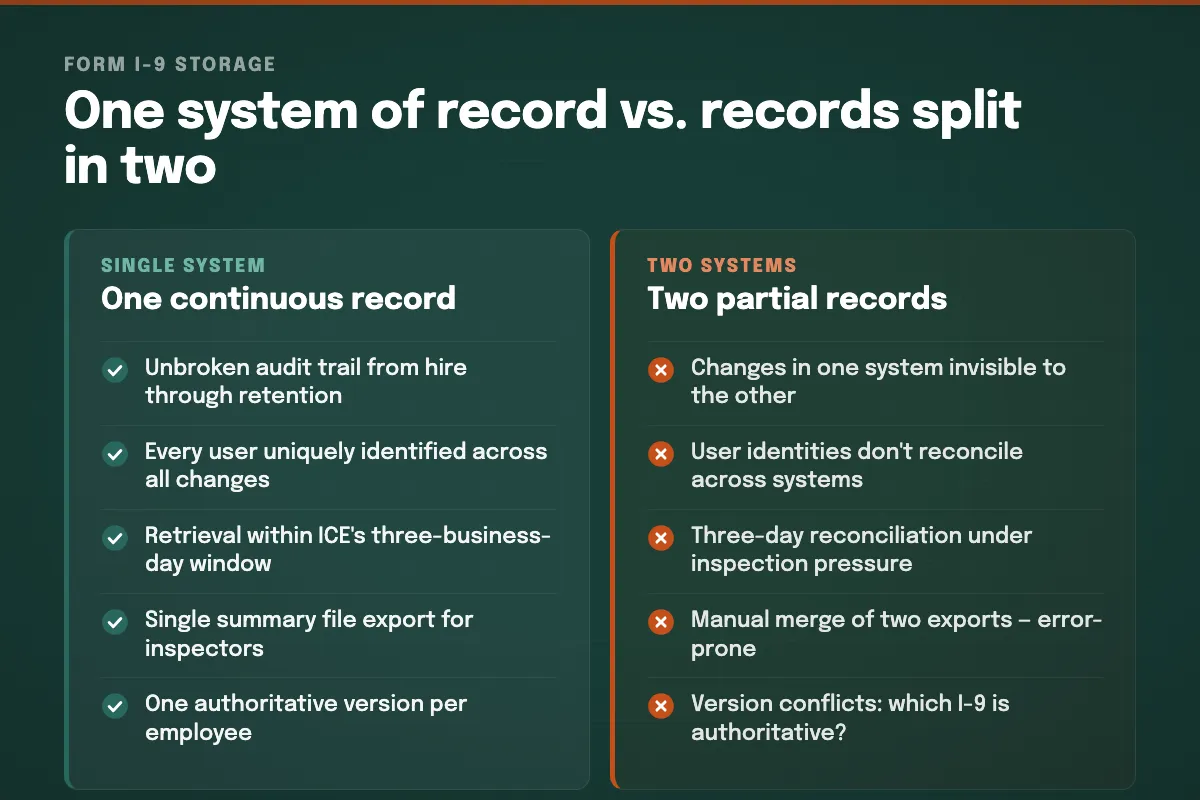
The federal requirements assume one continuous record per employee. Split the record across two systems and several of those requirements become very difficult to satisfy.
| Requirement (8 C.F.R. § 274a.2) | Why it breaks across two systems |
|---|---|
| Audit trail — every change to the form must be electronically stored and accessible to an inspecting agency | When Section 1 is captured in System A and Section 2 in System B, neither system has a record of changes made in the other. There is no single, continuous audit trail to produce. |
| Unique identification of each person who accesses, corrects, or changes a Form I-9 | User identities don't reconcile between systems. An auditor reviewing a correction can't always determine who made it, when, and in which system the change first occurred. |
| Indexing so any particular record can be accessed immediately | Records have to be located in both systems and stitched together by an HR generalist under time pressure. The slower the retrieval, the more substantive errors surface during inspection. |
| Integrity and reliability — controls to prevent unauthorized alteration or deletion | Two systems doubles the surface area. If either system's controls are weaker, the whole record is in question. |
| Retrieval, reading, and reproduction within three business days of a Notice of Inspection | Three days is short. Pulling a clean, complete record set from two systems — including reverifications, corrections, and supporting documents — frequently exceeds that window. |
| Summary files (spreadsheets of all electronically stored I-9 data fields, when requested) | No single system can export a complete summary file. The employer has to merge exports manually — and any merge error becomes an inspection finding. |
Of all the requirements above, the audit-trail provision is the one that turns a paperwork problem into a substantive violation. 8 C.F.R. § 274a.2(e) requires controls "to ensure an audit trail so that any alteration or change to the form since its creation is electronically stored and can be accessed by an appropriate government agency inspecting the forms."
That's a strong word: any. Every change. Every correction. Every reverification. Every Supplement B entry. Every time someone opens a record to view it.
In a single-system setup, the audit trail is one continuous log per I-9. In a split setup, you have two partial logs that don't reference each other. If an employee's name was corrected in the HRIS but the corresponding I-9 in the compliance system wasn't updated — or worse, was updated separately and now reads differently — there is no system of record that captures both events. From ICE's perspective, the audit trail isn't reliable.
When ICE issues a Notice of Inspection, employers have three business days to produce the requested I-9s along with supporting documents. (See our guide to the 3-day rule for what's required.)
If your I-9s are split across two systems, that three-day clock is also a stitching exercise. Someone on your team has to:
Three days isn't enough time for a clean reconciliation across hundreds or thousands of employees. And the errors that surface under that pressure — mismatched names, missing reverifications, gaps in the audit trail — are exactly what ICE flags as substantive violations. Current paperwork-violation penalties range from $288 to $2,861 per Form I-9 (most recent Federal Register adjustment, effective January 2, 2025), so the cost of a messy file structure compounds quickly. See our full 2026 I-9 penalties breakdown for the complete fine schedule and how ICE calculates per-violation amounts.
The other risk in a split setup is version conflict. If Section 1 lives in your HRIS and Section 2 lives in a separate compliance tool, what happens when a corrected name, address, or document is updated in only one system? Which version is the I-9 of record?
Federal regulations don't anticipate this question because they assume a single source of truth. The DOJ/ICE December 2023 memo reinforces it: the software must "uniquely identify each person accessing, correcting, or changing a Form I-9" and "record and display all information entered, including for reverification and rehire." Both statements assume the form lives in one place.
The compliant pattern is straightforward: one system of record for the Form I-9 itself, with integrations into your HRIS for triggers and status writebacks.
Most HCM-native I-9 modules are not built to satisfy 8 C.F.R. § 274a.2(e)–(i) on their own. They handle Section 1 collection reasonably well, but reverification tracking, audit-trail granularity, indexing, and inspector-scoped access tend to be weak or missing. We map those gaps platform by platform in I-9 and Your HRIS: What Workday, ADP, UKG, and Every Other Platform Leave Uncovered.
The temptation is to bridge the gap by keeping the HCM module for capture and bolting on a separate compliance tool for storage. That's the split setup this article is about — and it carries the risks above.
A cleaner pattern: keep the HCM as your system of record for everything except I-9s, and use an integration to send hire, termination, and location-change events to a dedicated I-9 compliance platform. The I-9 itself originates and lives in one place, and your HCM still drives the hiring workflow.
"The audit trail is the one thing you can't reconstruct after the fact. Either it was captured continuously from the day the I-9 was created, or it wasn't — and an inspector can see the difference in about thirty seconds. That's why we push so hard on a single system of record. It's not a product preference; it's what the regulation actually asks for," says Patricia Duarte, Director of Compliance at i9 Intelligence.
If you're considering consolidating I-9 records out of an HCM module or off paper, we can walk you through the audit-trail, integration, and migration mechanics on a short call. Schedule a free compliance call or book a demo.
Our US-based compliance team can review your existing I-9 storage architecture and flag the audit-trail or retrieval gaps before ICE does.