
How Much Does Remote I-9 Verification Cost? 2026 Prices Compared
Read the article

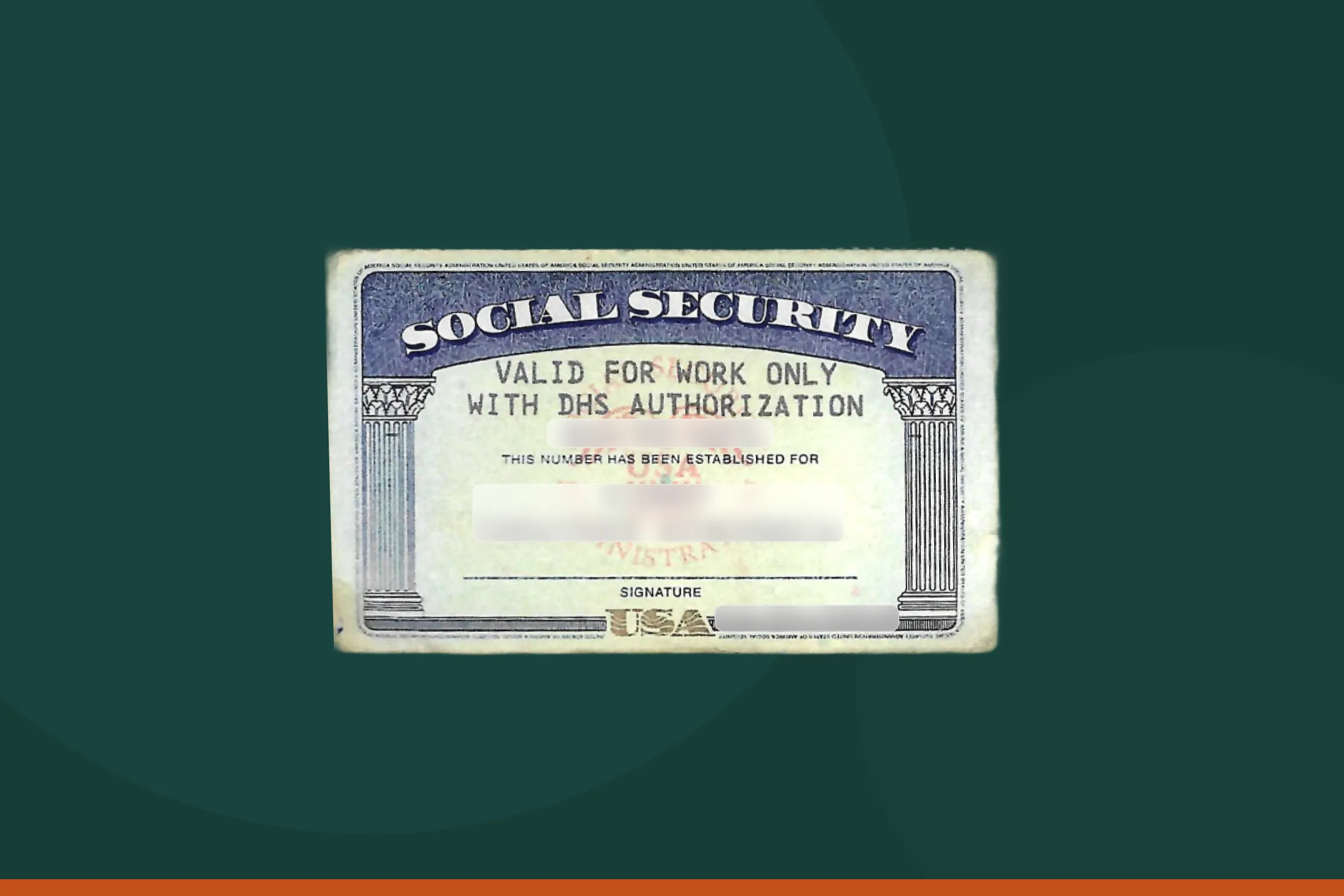
If a new hire hands you a Social Security card that says "VALID FOR WORK ONLY WITH DHS AUTHORIZATION," you cannot accept it as a List C document on Form I-9. This is one of three restricted Social Security card types that the Social Security Administration (SSA) issues to noncitizens whose work authorization is tied to their immigration status.
The restriction means the cardholder was authorized to work in the United States only for a specific period or under specific conditions set by the Department of Homeland Security (DHS). While the card confirms the person has a Social Security number, it does not establish employment authorization on its own — which is exactly what List C documents are supposed to do.
This is a common point of confusion for employers completing Form I-9. Knowing how to handle restricted Social Security cards correctly protects your company from I-9 violations and helps you avoid unintentional discrimination.
The SSA issues four types of Social Security cards. Only one, the unrestricted Social Security card, is acceptable as a List C document for Form I-9. This table covers every card type, who receives it, and exactly how to handle it during the I-9 process:
| Card Type | Who Receives It | List C Eligible? | E-Verify SSN Required? | Employer Action |
|---|---|---|---|---|
| Unrestricted (no notation) | U.S. citizens, lawful permanent residents, refugees, asylees, noncitizen nationals, Compact of Free Association citizens | Yes (if not laminated) | Yes | Accept as List C document. Record in Section 2. |
| VALID FOR WORK ONLY WITH DHS AUTHORIZATION | Noncitizens with temporary DHS work authorization (H-1B, TPS, DACA, parolees, etc.) | No | Yes | Reject for I-9. Ask employee to choose a different List A or List C document. |
| VALID FOR WORK ONLY WITH INS AUTHORIZATION | Same as above — older version issued before DHS replaced INS in 2003 | No | Yes | Reject for I-9. Same rule as DHS version. |
| NOT VALID FOR EMPLOYMENT | Noncitizens admitted without work authorization (SSN issued for non-work purposes such as government benefits) | No | Yes | Reject for I-9. Ask employee to choose a different List A or List C document. |
Source: USCIS Acceptable Documents for Form I-9 and M-274 Handbook for Employers, Sections 4 and 13.
Unrestricted Social Security cards — the only type acceptable as List C documents — are issued only to:
Everyone else who receives a Social Security number — including noncitizens with temporary work visas (H-1B, L-1, TN, etc.), TPS holders, DACA recipients, and parolees — receives a restricted card. This doesn't mean they can't work. It means their work authorization comes from DHS, not from the Social Security card itself.
"The restricted Social Security card is one of the most misunderstood I-9 documents I see," says Patricia, Director of Compliance at i9 Intelligence. "HR sees a valid SSN on a government-issued card and assumes it works for List C. It doesn't. The notation — 'valid for work only with DHS authorization' — is a flag that this person's work authorization lives somewhere else: a DHS-issued EAD, a foreign passport with I-94, a permanent resident card if their status has changed. The card confirms the SSN, not the authorization."
No. According to the USCIS Handbook for Employers (M-274), restricted Social Security cards are not acceptable List C documents. If an employee presents a restricted card during the I-9 process, you must ask the employee to provide a different document from either List A or List C.
This applies to both initial verification (Section 2) and reverification (Supplement B). Per M-274 Section 14: "If the employee presents a restricted Social Security card, you must reject it since it is not an acceptable Form I-9 document and ask the employee to choose a different document from List A or C."
One additional rule: even unrestricted Social Security cards must not be laminated to be acceptable for I-9.
Accepting a restricted Social Security card as a List C document is an automatic I-9 paperwork violation. Under current penalty amounts (effective January 2025 per 8 CFR § 274a.10), each violation carries a fine of $288 to $2,861 per Form I-9.
To put that in perspective: an employer who incorrectly accepts restricted Social Security cards from 10 new hires faces $2,880 to $28,610 in paperwork fines alone. If any of those workers are also found to be unauthorized, knowing-hire penalties of $716 to $5,724 per worker apply on top — bringing the total exposure for 10 workers to $10,040 to $85,850.
For a full breakdown of every current penalty amount and how ICE calculates fines, see I-9 Penalties in 2026: Every Fine Amount Employers Need to Know.
Document questions like this come up every day. Our I-9 compliance specialists handle Section 2 verification for you — including document review — so your team doesn't have to guess. Schedule a free compliance call or try our I-9 Risk Calculator to see where your company stands.
If a new hire presents a Social Security card with any of the three restricted notations, follow these steps:
A restricted Social Security card reflects the person's immigration status at the time the card was issued — not today. Many employees with restricted cards have since gained permanent work authorization, but they still carry the old card in their wallet because the SSN on it is still valid for tax and banking purposes.
Common scenarios:
Your only question during the I-9 is whether the document in front of you is acceptable for List A, B, or C as it appears today. The employee's status history and what documents they could present are not relevant to the form. You evaluate only what's presented. If the restricted card is what they hand you, you cannot accept it — regardless of whether they now have other documents in their file or at home.
Even though you cannot accept a restricted Social Security card as a List C document, you must still enter the employee's Social Security number in E-Verify. Per USCIS guidance: "Although these cards are not acceptable to demonstrate employment authorization, employers using E-Verify must still enter the Social Security number when creating the case."
The employee will provide their SSN in Section 1 of Form I-9 (which they complete themselves). E-Verify uses this number to verify employment authorization through the SSA and DHS databases — regardless of which documents the employee presented for Section 2.
For more on how E-Verify works with Form I-9, see our E-Verify overview.
These are the mistakes we see most often when employers encounter restricted cards:
Both are restricted Social Security cards and neither is acceptable for I-9. The difference is in who receives them. "Valid for Work Only with DHS Authorization" goes to noncitizens who have temporary work authorization from DHS. "Not Valid for Employment" goes to noncitizens who were issued an SSN for non-work purposes — such as receiving certain government benefits. In both cases, the employee must present a different document for I-9 verification.
No. You cannot refuse to hire someone because their Social Security card is restricted. The card restriction does not determine whether someone is authorized to work — it only means that particular card cannot serve as a List C document. The employee may have other valid documents (such as an Employment Authorization Document or a foreign passport with I-94) that establish their work authorization.
Not necessarily. Many people with restricted cards are fully authorized to work. The restriction means their work authorization comes from DHS rather than from their citizenship or permanent resident status. H-1B visa holders, TPS beneficiaries, DACA recipients, and many other noncitizens with valid work authorization receive restricted Social Security cards.
An employee who was issued a restricted card may have since become a lawful permanent resident or even a U.S. citizen. However, the old restricted card is still not acceptable for I-9 purposes. The employee would need to present a different acceptable document — such as their Permanent Resident Card (List A), unrestricted Social Security card (List C), or U.S. passport (List A).
If an employee presents a Social Security card during reverification (Supplement B), you must verify it is unrestricted. Per M-274: if the employee presents a restricted Social Security card during reverification, you must reject it and ask the employee to choose a different document from List A or List C. The same rules apply as during initial Section 2 verification. For TPS reverifications specifically — including El Salvador at the Sept. 9, 2026 termination — see the SS-card FAQ in our TPS Status for Employers guide.
Our team of I-9 and E-Verify experts is here to help: