
DOL Suspends Microsoft, Adobe, and Six IT Firms From PERM: What It Means for Form I-9
Read the article

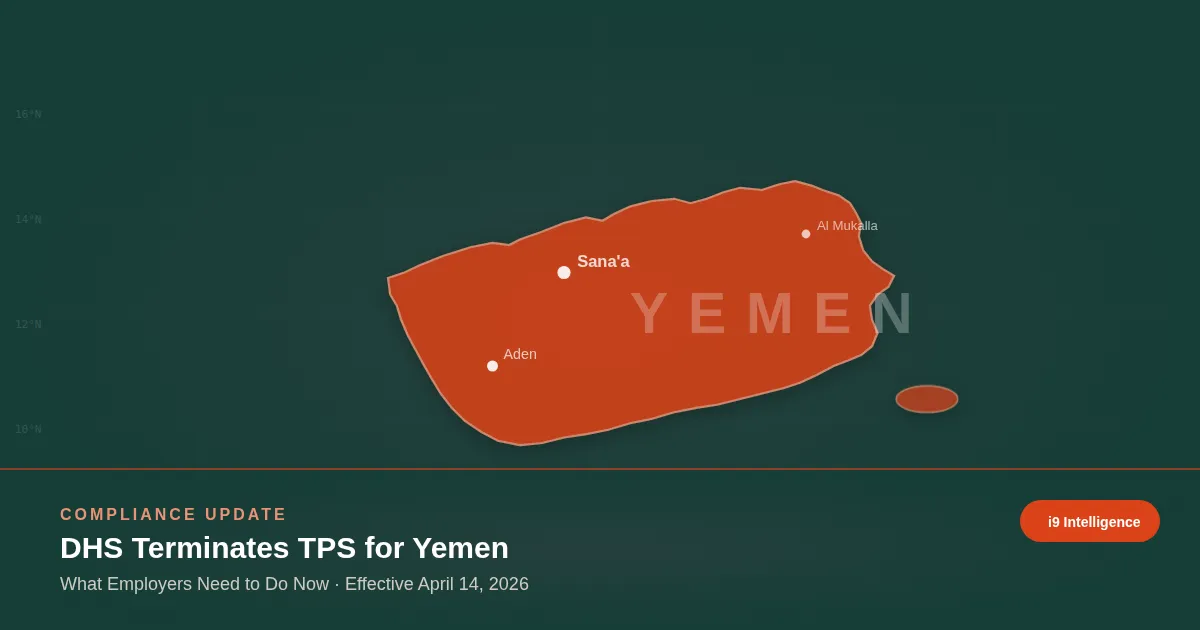
On February 13, 2026, Secretary of Homeland Security Kristi Noem announced the termination of Temporary Protected Status for Yemen. The formal termination notice was published in the Federal Register on March 3, 2026 (FR 2026-04179), setting the effective termination date as May 4, 2026.
Yemen was originally designated for TPS on September 3, 2015, based on ongoing armed conflict. DHS extended or redesignated Yemen for TPS in 2017, 2018, 2020, 2021, 2023, and 2024. The most recent TPS period was set to run through March 3, 2026, but the termination supersedes that — TPS benefits continue through the 60-day wind-down period ending May 4, 2026.
This is not an extension or a court-ordered stay. Unlike the recent Haiti TPS court stay, there is currently no court order blocking this termination. When May 4, 2026 arrives, affected employees will lose their TPS-based work authorization.
This affects employees holding Yemen TPS Employment Authorization Documents (EADs). There are two groups to look for:
EADs that were auto-extended:
USCIS automatically extended EADs with these original expiration dates through September 3, 2025:
EADs issued after re-registration:
Employees who re-registered and received a new EAD were issued cards expiring March 3, 2026.
Regardless of the date printed on the card, all Yemen TPS-based work authorization remains valid through May 4, 2026 — the 60-day wind-down period following the March 3, 2026 Federal Register notice.
If an employee has a Work Authorization Card (Form I-766, category A12 or C19) with Country of Birth as Yemen, their work authorization will end on May 4, 2026 unless they obtain a new basis for employment.
Find out where your compliance gaps are. Use our free I-9 Risk Calculator to estimate your audit exposure, or book a demo to see how i9 Intelligence can help.
Step 1: Identify affected employees
In i9 Intelligence, run the Expiration Date Report under Reports > Compliance > Expiring Docs Report. This report shows all employees with expiring documents — it does not filter by document type or country. Look for employees with expiration dates matching the dates listed above (September 3, 2024, March 3, 2023, or March 3, 2026). Then open each record individually to verify the Work Authorization Card shows Country of Birth as Yemen and category code A12 or C19.
Step 2: Notify affected employees
Let affected employees know that their TPS-based work authorization will expire on May 4, 2026. They should consult with an immigration attorney about their options — some may have other bases for work authorization (a pending asylum case, an approved visa petition, etc.).
Step 3: Do not take early action
Do not terminate employment or change the employee's status before the effective date. Their work authorization remains valid until then. Taking action early based on TPS status or national origin could constitute discrimination under the Immigration and Nationality Act's anti-discrimination provisions.
Step 4: Re-verify or end employment
When the employee's TPS-based EAD expires on May 4, 2026, they must present a new document showing continued work authorization. Complete Supplement B (formerly Section 3) of the I-9:
In i9 Intelligence:
The system will flag these employees through the Expiring Documents dashboard as May 4 approaches. When re-verifying, select the Supplement B tab on the right-hand side of the form to complete reverification.
Step 5: Update E-Verify if applicable
If you used E-Verify for the original hire, no E-Verify action is required for reverification. E-Verify is only used for new hires, not reverification.
Do not panic-fire employees. This is a common and costly mistake. Employers who terminate employees before their work authorization actually expires — or who treat Yemen-born employees differently based on the TPS announcement — risk discrimination claims.
The rules are straightforward:
It is possible. Federal courts have issued last-minute stays blocking TPS terminations for Haiti and Burma in recent months. If a court issues a stay for Yemen, we will publish updated guidance immediately.
Employers should:
| Date | What Happens |
|---|---|
| February 13, 2026 | DHS announces termination of Yemen TPS |
| March 3, 2026 | Federal Register notice published (FR 2026-04179) — 60-day clock starts |
| March 3, 2026 | Original TPS period end date (superseded by 60-day wind-down) |
| May 4, 2026 | Termination effective — EADs expire, reverification required |
If you are an i9 Intelligence client, our support team can help you identify affected employees and prepare for the reverification process.
Call us at (713) 668-6200 (Mon–Fri, 8am–5pm CT), email support@i-9intelligence.com, or submit a ticket.
If you are handling I-9 compliance manually, TPS terminations create a tight window where every affected employee needs to be identified, notified, and reverified on time — without acting too early and triggering discrimination risk. i9 Intelligence provides its own trained authorized representatives who handle Section 2 verification on behalf of your organization, and our Expiring Documents dashboard flags affected records automatically so nothing falls through the cracks. Book a free compliance call to discuss your Yemen TPS exposure.
This article reflects USCIS and DHS guidance current as of March 9, 2026. The Federal Register termination notice (FR 2026-04179) was published March 3, 2026, setting a May 4, 2026 termination date. The situation may change if a federal court issues a stay or if DHS revises the termination timeline. Check uscis.gov for the latest updates. This article is for informational purposes only — consult legal counsel for guidance specific to your organization.